
BGS grading: what you need to know.
Read BGS manga grades: book, dust jacket, pages, obi and alterations. Interactive scales, dimensions, sleeve sizing and price comparisons.
You see a manga for sale. It is the right title, the cover looks beautiful and the slab carries a high grade. Is that enough to judge the price? You need to understand which part was assessed, what comes with the book and what the notes reveal.
Beckett launched tankōbon grading in January 2024 and extended it to zasshi that October. It helped give the graded-manga market a shared language and is the grader represented in our sales database. Understanding how it reads a book is useful even if you only buy raw copies. [1]
The big number.
And everything around it.
The slab is the sealed rigid holder. Its label identifies the manga and describes its condition. Before looking at the grade, check title, volume, publisher and printing: a strong result for another edition does not establish the value of yours.
The main grade assesses the volume: the cover beneath the jacket, spine, pages, binding and integrity.
The removable jacket receives a separate assessment. A 10 book can have a 9.8 jacket, as the Fate/Grand Order example below shows.
A description records paper quality. White and Off-White are categories, not a third numerical grade.
An obi can be recorded as included, without a separate grade. Treatments and other details also appear here.
The book grade is not an average of these fields. Read them separately, then consider them together. Check the certification number too: request a readable photograph and verify the details through the grading company when its service is available.
For identification, start with our first-print guide. For authenticity, follow the separate guides to counterfeit tankōbon and counterfeit zasshi.
One decimal can change
the comparison.
The manga scale reaches 10 and uses smaller steps at the top: 9.0, 9.2, 9.4, 9.6, 9.8, 9.9, 10. It differs from the BGS trading-card scale. Moving from 9.6 to 9.8 can coincide with a substantial price change; it does not mean the book is “2% better”. Grades rank condition rather than measuring value proportionally. [2–3]
Four pieces of information.
Not an average.
Change the fields to see how they read together. This is a teaching example, not a prediction of your manga’s grade.
Dust jacket9.6
Page qualityWhite
ObiIncluded · no grade
0.5 · Poor At the lower end of the scale, inspect integrity, missing parts and notes especially carefully.
1.0 · Fair At the lower end of the scale, inspect integrity, missing parts and notes especially carefully.
1.5 · Intermediate grade At the lower end of the scale, inspect integrity, missing parts and notes especially carefully.
1.8 · Intermediate grade At the lower end of the scale, inspect integrity, missing parts and notes especially carefully.
2.0 · Good At the lower end of the scale, inspect integrity, missing parts and notes especially carefully.
2.5 · Intermediate grade At the lower end of the scale, inspect integrity, missing parts and notes especially carefully.
3.0 · G/VG At the lower end of the scale, inspect integrity, missing parts and notes especially carefully.
3.5 · Intermediate grade At the lower end of the scale, inspect integrity, missing parts and notes especially carefully.
4.0 · VG Condition is only one part of the decision. Read the defects and completeness, then compare the same publication.
4.5 · Intermediate grade Condition is only one part of the decision. Read the defects and completeness, then compare the same publication.
5.0 · VG/F Condition is only one part of the decision. Read the defects and completeness, then compare the same publication.
5.5 · Intermediate grade Condition is only one part of the decision. Read the defects and completeness, then compare the same publication.
6.0 · F Condition is only one part of the decision. Read the defects and completeness, then compare the same publication.
6.5 · Intermediate grade Condition is only one part of the decision. Read the defects and completeness, then compare the same publication.
7.0 · F/VF Read this grade in context: a modern tankōbon and a historical magazine can have very different populations and demand.
7.5 · Intermediate grade Read this grade in context: a modern tankōbon and a historical magazine can have very different populations and demand.
8.0 · VF Read this grade in context: a modern tankōbon and a historical magazine can have very different populations and demand.
8.5 · Intermediate grade Read this grade in context: a modern tankōbon and a historical magazine can have very different populations and demand.
9.0 · VF/NM Small numerical steps, potentially large price differences. Check the book, jacket and edition before comparing sales.
9.2 · NM− Small numerical steps, potentially large price differences. Check the book, jacket and edition before comparing sales.
9.4 · NM Small numerical steps, potentially large price differences. Check the book, jacket and edition before comparing sales.
9.6 · NM+ Small numerical steps, potentially large price differences. Check the book, jacket and edition before comparing sales.
9.8 · NM/M Near Mint/Mint. A high-condition target for tankōbon collectors; officially it is not called Gem Mint.
9.9 · Mint Mint: a distinct step above 9.8. This is not the trading-card Black Label.
10.0 · Gem Mint The top of the manga scale. Its official name is Gem Mint.
The sequence runs from 0.5 to 10, with smaller steps at the top. Incomplete is a separate case: CBCS also documents 0.1 and 0.3 for incomplete copies. These states are not shortcuts to grading a book remotely. [2–3]
Read page quality rather than guessing it
The descriptions below appear on labels. We retain the original wording and explain its meaning. You can also select each description in the interactive panel.
- Exceptional WhiteExceptional white
- WhiteWhite
- Off-White/WhiteBetween off-white and white
- Off-WhiteOff-white / ivory
- Cream/Off-WhiteBetween cream and off-white
- CreamCream
- Light Tan/Off-WhiteLight tanning / off-white
Seven descriptions recorded in our database, not an exhaustive official catalogue. Colour samples are illustrative: lighting, cameras and screens prevent using them to assign a copy’s page quality.
Exceptional White is recorded on a Ranma ½ graded 8.5 in our database: very white pages do not automatically produce an exceptional book grade. Beckett also documents that wording on a Dragon Ball debut magazine. [5]
The book grade is a useful starting point for comparable sales. Jacket and pages add details that can matter considerably, particularly between copies of the same grade. No fixed percentage of the price belongs to each field.
No grade.
Sometimes, a major part of the price.
The obi is the paper band. On the slabs documented here you see Includes obi, rather than a number summarising its condition. Yet its value can be substantial: for someone seeking a complete copy, finding the correct band may be harder than finding the book.
Collectors also seek and trade separate obi. A heavily worn band can still be desirable, particularly for a historical volume; authenticity, the correct match and completeness remain essential. Folds, tears, repairs and cut-out coupons do not stop mattering because there is no numerical grade.
“Included” records a band’s presence: by itself it does not establish that it belongs to the first printing. Explore our archive: Jujutsu Kaisen for the coupon, Vagabond for completeness and variants, and Kagurabachi for a case where the band’s appearance alone cannot identify the printing. Some editions were issued without an obi: do not penalise them for an accessory they never had.
To measure an obi premium, compare sales of the same volume and grade, matching jacket, pages, status and period as closely as possible. The live comparison further down provides a concrete example.
9.8, 9.9, 10.
Three distinct steps.
Collectors sometimes call a 9.8 tankōbon a “gem”. In our market analysis it is a practical high-condition threshold. Beckett’s official terminology is more specific:
| Manga grade | Official name | How to read it |
|---|---|---|
| 9.8 | Near Mint/Mint · NM/M | A high-condition target for many tankōbon collectors. |
| 9.9 | Mint | A distinct level requiring its own population and sales comparisons. |
| 10 | Gem Mint | The top of the manga scale. |
A small step in grade can mean a large step in price. Establish that premium from completed sales of the same title, printing and accessories. Very high asking prices show what a seller hopes to receive; they cannot establish that a 9.9 typically sells for ten times a 9.8.
The 10 exists. Read what this label says.
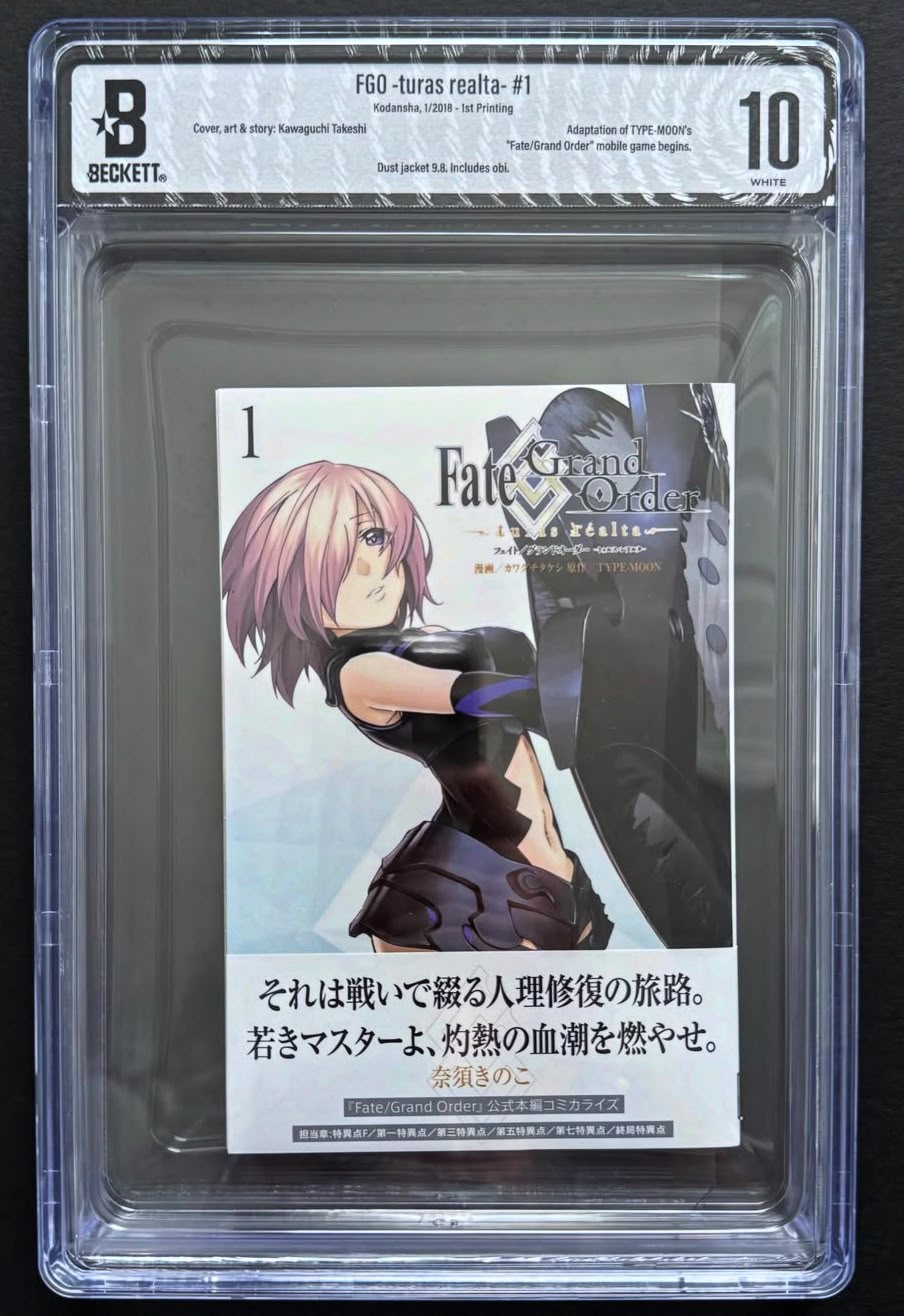
Dust jacket 9.8. Includes obi.Photo: collector’s Instagram post. The photograph documents one copy with a 10 label, not the worldwide number of such copies. Its certificate cannot be verified from this view alone. [7]To establish how many copies are currently certified, use a dated Population Report. Claiming “only two exist” without that check can make a guide inaccurate or outdated.
For zasshi, the context changes
A weekly magazine was made to be read, folded, passed around and often discarded. A well-preserved historical issue can be difficult to find. That is why our analysis also uses 9.0 and above as a high-condition threshold for zasshi; it does not rename the grade Gem Mint.
Our Weekly Shōnen Jump #34 from 1997 example contains 4 copies at 9.0 or above among 118 certifications in the 18 August 2026 snapshot, which includes Conserved copies. This is a specific sample, not the distribution of every magazine. Even 7.5 can be a strong result for a historical zasshi; the same number on a modern release needs a different reading.
Gem rate is a percentage: certifications meeting a stated threshold divided by the sample total, multiplied by 100. It is not another word for a grade, nor an arbitrary raw copy’s chance of reaching it. Our population guide explains the example, distribution and limitations.
A high grade does not erase
a treatment.
When a few decimals can change the price, “improving” a book before submission can be tempting. That is the moment to understand what an intervention actually does. Sanding edges, trimming a cover, lightening paper or repairing a part can leave traces that Beckett detects and records.
Read the classification and especially the central note, where jacket and obi details also appear. The print is small, and listing titles may omit it. Inspect the label photograph even when the seller focuses only on the grade.
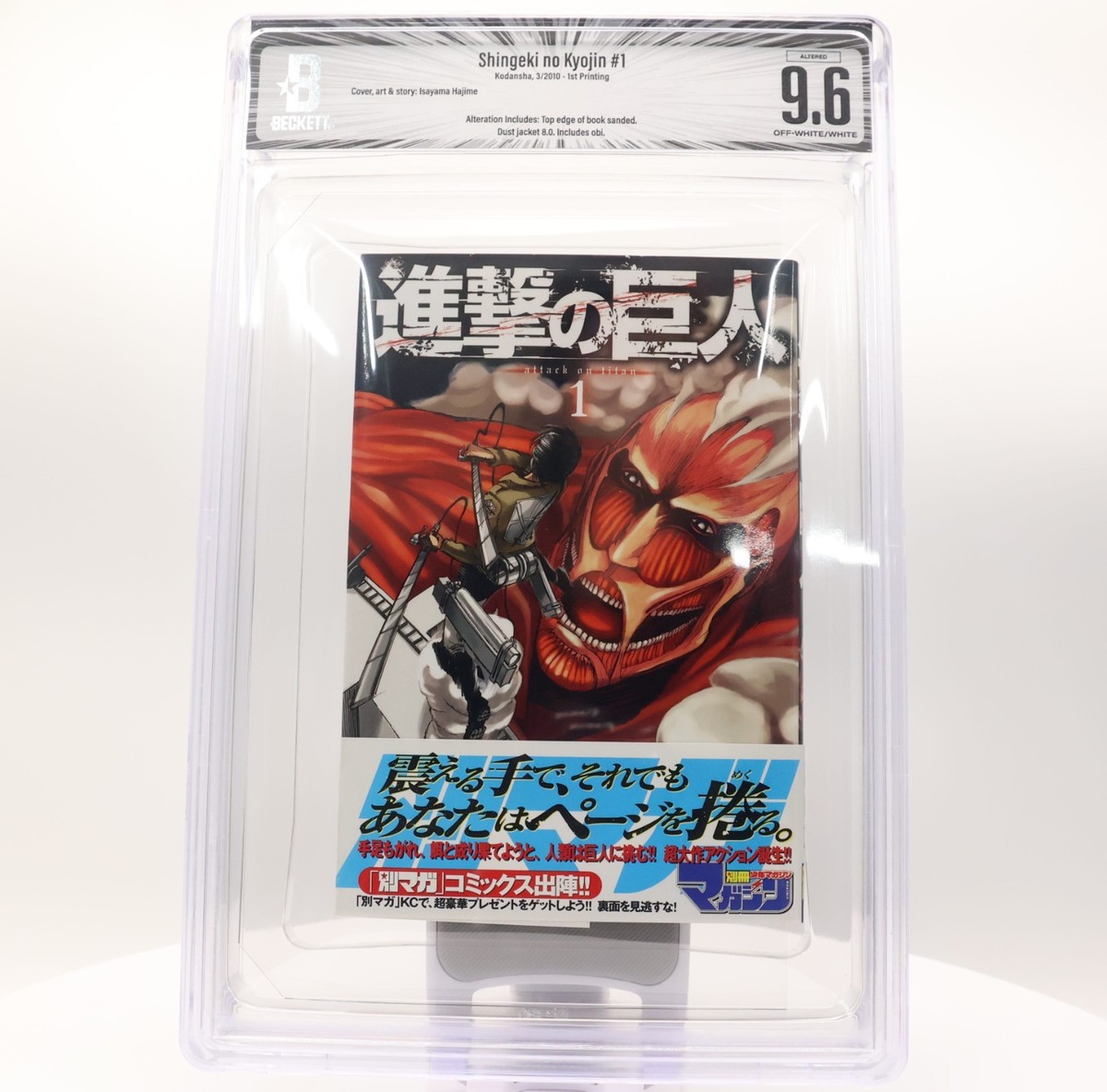
Alteration Includes: Top edge of book sanded.
Dust jacket 8.0. Includes obi.[8]If you come from TCG collecting, do not assume treatment makes the numerical grade disappear. The manga examples we have documented retain numerical grades alongside classifications and treatment notes. Trading-card companies and services do not all handle alterations identically either.
These copies can remain tradable, often at much lower prices than examples without declared interventions. Compare them as a separate segment. Altered, Conserved, Restored and Married are not interchangeable terms: our alteration guide explains eight photographed examples with their complete central BGS notes.
Before submitting,
remove the jacket and inspect the book.
It is an easy step to skip when the outer cover wins you over. Take your time, use a clean surface and avoid forcing the binding. Start with the volume itself, then examine the jacket and accessories.
- Front and back covers. Look for folds, dents, grooves, scratches, abrasion, stains and colour changes. A straight-on photo can hide an indentation: examine the surface under oblique light too.
- Spine, corners and binding. Inspect crushing, opening creases, worn ends, separation and glue traces. Do not force the book beyond its natural opening resistance.
- Page edges and interiors. Check top, bottom and fore-edge for yellowing, stains, waviness, tears, cuts and missing leaves. White pages do not rule out structural damage.
- Dust jacket. Examine both sides, flaps, folds, edges and corners. Its separate grade may help explain different prices for books with the same main grade.
- Obi and completeness. Check the correct design, continuity of the band, any expected coupon and repairs. Photograph the colophon and inserts too.
- Treatment traces. If something looks wrong, seek another opinion before trying to clean it. Do not remove a defect simply to chase a decimal.
Build a plausible grade range, not a promise. In Graded prices, select several grades to compare a cautious outcome with a better one. Use the five-view galleries in the archive as photographic references. Our WhatsApp community can help you discuss a preliminary assessment; the grading company makes the final decision.
Before shipping, confirm accepted formats, packaging instructions and service availability directly. Our format and protection guide helps with choosing a suitable sleeve.
Six designs.
Your choice.
You choose the label artwork, rather than the colour of the plastic holder. Beckett offers six options independently of the grade. A red or purple design does not indicate a condition category or an alteration. [4]
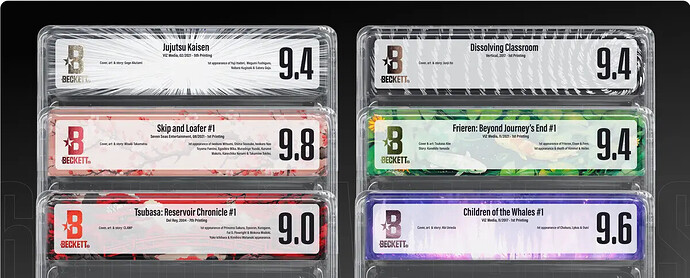
- Speed LinesDynamic lines · white and grey
- Horror SpiralSpiral · grey and black
- Cherry BlossomsCherry flowers · pink
- Lily PadsWater lilies · green
- Red BridgeRed bridge · red and black
- WisteriaWisteria · purple
How much room does it need?
Start with the right dimensions.
A slab protects the manga, but adds bulk. Before choosing a sleeve, display or shelf, distinguish the book that fits inside from the holder you need to store.
Tankōbon
150 × 208 × 21 mmWidth × height × thickness
Zasshi
181 × 259 × 41.27 mmWidth × height × thickness
Front silhouettes are proportional to each other. Maximum content dimensions, not external slab dimensions. These are Beckett’s metric figures, not the standard size of every manga or magazine. [4]
For a sleeve, measure the closed slab.
Measure width, height and thickness at the outermost points, including rims and protrusions. A flat sleeve must wrap around the thickness too: matching only the slab’s front width is not enough. Usable body height and the closure flap are different measurements.
Make room for your collection.
The initial values are a teaching example, not official BGS specifications. Replace them with your holder’s measurements. All dimensions are in millimetres.
Before adding clearance, seams and closure space. This is not a ready-to-buy size.
Height 280 mm · depth 180 mm. Minimum footprint, excluding gaps, sleeves and supports.
How to read the calculation
For a flat, non-gusseted bag, the geometric baseline is width + thickness; for the open body, height + half the thickness. This excludes insertion clearance, seams and closure. A zip narrows the opening; a flap needs extra space. Check usable internal dimensions and the manufacturer’s stated compatibility, then try one sleeve without forcing it. [10]
The row occupies at least the number of slabs × thickness. Allow extra room for protectors, gaps and supports; a display stand may have a different footprint.
Choose protection that slides on without pressure and check where the adhesive sits. For materials and storage, continue to our format and sleeve guide.
A raw copy’s price
starts with its condition.
Two ungraded copies of the same volume can look similar in a listing yet have very different prospects after inspection. In a market that distinguishes condition, buyers have reason to consider the potential grade, alongside edition, obi and possible interventions.
A broad raw-price average can therefore be misleading: it mixes worn copies, better examples, different accessories and incomplete descriptions. That number becomes useful only when you know which copies it includes.
Buying raw and grading can create value for someone skilled at selecting copies. The margin depends on the purchase price, actual result and proceeds after costs. That also applies to a 7.5 zasshi: a strong grade in its context does not, by itself, make the purchase profitable.
Cautious net proceeds − raw purchase − grading − shipping and other costs = possible margin
Include selling fees, insurance and applicable charges without counting them twice. Use several completed sales, not the highest asking price. If the purchase only works at the best imaginable grade, you are relying on a very narrow outcome.
Same grade, details that change the price
Switch between with/without obi and with/without alterations. The panels read our database and show sales, periods and observed differences while matching several attributes. Samples can be small and cannot isolate every difference between copies.
How to compare in Graded prices
Choose the title and printing, then narrow grade, obi, status, jacket, pages and period. Multiple grades can be selected, but begin at the same grade when studying an accessory. The median describes the selected sales: with few results, inspect every row’s date, photo and notes. The obi premium compares group medians; it does not prove the band alone explains the difference.
Will the grading premium shrink? It could: more certified supply and buyers better able to assess raw books may reduce part of the information advantage. That is our market hypothesis, not an established forecast. Demand, scarce high grades and confidence in certification may pull the other way.
What if I choose another grading company?
This guide covers Beckett. EGC, GRAAD and other operators have their own services and criteria: check their rules before submitting. An identical number from different companies does not automatically imply identical standards or prices.
Questions to keep in mind
Does BGS grade the obi?
On the slabs documented here, the obi is recorded as included without a separate numerical grade. Still check authenticity, design, integrity and any coupon: presence alone does not establish these.
Must a 10 book also have a 10 dust jacket?
No. The Fate/Grand Order photograph shows a 10 book with a 9.8 jacket. These are separate assessments.
Does 9.8 mean Gem Mint?
On Beckett’s official manga scale, 9.8 is Near Mint/Mint, 9.9 is Mint and 10 is Gem Mint. “Gem 9.8” is informal collector language. Gem rate instead measures the percentage reaching a stated threshold.
Is 9.9 the manga Black Label?
That is an informal analogy. The BGS trading-card Black Label identifies four 10 subgrades; it is not the name of a 9.9 manga certification and does not guarantee a price multiplier.
Can an altered manga receive a numerical grade?
Yes: the photographic examples show numerical grades alongside classifications and intervention notes. Price comparisons must consider both.
Is 7.5 a good zasshi grade?
It can be for a historical magazine that is difficult to find well preserved. Title, era and population matter. A raw-to-graded profit also depends on purchase cost, service costs and the actual sale price.
Can I know the grade before submitting?
A complete inspection and suitable photographs can support a reasoned estimate. A single picture or this interactive scale cannot establish the final result; that decision belongs to the grading company.
Sources and photographs
Reviewed 16 October 2026. Official terminology, photographs and market interpretation are distinguished in the text. Beckett pages may redirect to maintenance: indexed official content was checked against available labels; confirm service availability before shipping.
- [1] Service launchBeckett · tankōbon launch, 10 January 2024
Zasshi expansion, 15 October 2024. Company press releases.
- [2–3] Scale and intermediate stepsBeckett · Manga Grading Scale
CBCS · comic-book grading FAQ, supplementary evidence for intervals and incomplete categories, not a separate manga rulebook.
- [4] Labels and serviceBeckett · Manga Grading
The six label names and illustration, label choice and maximum accepted manga dimensions. These describe the contents, not the holder’s exterior.
- [5] Page qualityBeckett · Weekly Shōnen Jump #51, Exceptional White
Other descriptions come from slab records in our database. Example: Ranma ½, grade 8.5. This is not an exhaustive official colour scale.
- [6] Trading-card Black LabelBeckett · Introducing BGS Black, 28 November 2014
The quad-10 card classification, distinct from manga grades.
- [7] Photograph of the grade-10 exampleCollector’s Instagram post · Fate/Grand Order
The original photo and label text are preserved. The photograph illustrates one copy; it is not a worldwide census of grade 10.
- [8] Treated exampleAttack on Titan · listing photograph
The central note is transcribed in full. Further examples in our alteration guide.
- [9] Project dataGraded prices · Population Report: dated example
Market comparisons update from the database. The cited Jump distribution is the 18 August 2026 snapshot, not a live count.
- [10] Measuring a flat bagNFC Bags · measuring guide
Width and depth allowances for a rigid object; usable body height and closure space are separate. Our calculator shows an ideal geometric baseline before clearance and closure, not a manufacturer-approved sleeve size.