
Counterfeit manga: how to check fake tankōbon
Fake manga: 38 photographs, One Piece and Dragon Ball comparisons, Shueisha’s Demon Slayer warning and other reported titles. Checklist and sources.
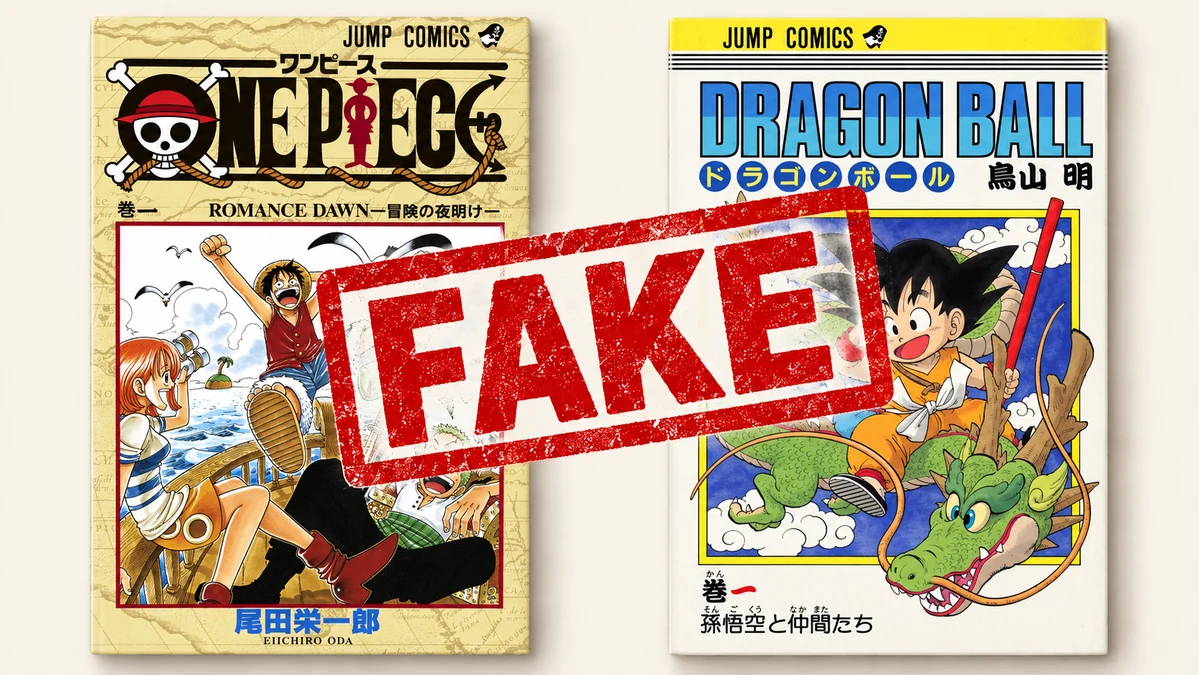
Title, language, publisher, edition and issue. Always compare the same publication.
Cross-check printing, margins, colophon and construction. One feature cannot authenticate a copy.
Ask for clear photographs of the actual copy, including inside. Tap guide photographs to enlarge them.
Where to start
You have found the volume you wanted. The cover looks right and the colophon carries the first-print date. That is a useful starting point, but one question remains: is the book genuine? Dates, ISBNs and printing statements can all be copied.
Open the book, remove its dust jacket and inspect how the text and artwork were reproduced. The photographs below show you where to look, with an explanation beneath each comparison. Where prose sits outside the photograph, the article view excludes it to give details more room; the full original remains available.
One distinction helps before you start: an official reprint is a genuine book from a later printing; an altered copy has undergone interventions. A replaced jacket or obi can also bring together genuine parts from different editions. These are different problems from counterfeiting and should be described accordingly.
One Piece · Volume 1
For One Piece 1, start by removing the dust jacket. In the counterfeit photographed by 1stPrint, the book’s cover shows a vertical line near the spine on the right. The box and arrows in the two photographs below point to that mark. The source calls it a “vertical line” without explaining how it was produced. [1]
Then compare the map edges and the opening illustration. The fake shows broken lines, distorted shapes and cropped artwork. The annotations distinguish these defects; each caption explains the specific highlighted detail.
Start with the line, then cross-check the other clues. A crease can also result from handling. What matters here is the comparison with a genuine copy of the same edition and the other defects in the photographed counterfeit.
The vertical line near the spine
[1]01 / 02

The long red box follows a vertical line on the fake’s bare cover, close to the spine on the right. The genuine copy on the left does not show the same distinct mark.
02 / 02

The arrows indicate a vertical line running down the counterfeit book’s cover near the spine on the right. The dust jacket has been removed. The original annotation identifies the line without explaining how it was produced; it does not establish a particular binding method.
The book without its dust jacket
[1]01 / 02

The dust jacket has been removed: these photographs show the book’s own cover. In the fake on the right, the source points out cropped printing, misaligned elements and distorted shapes caused by edge retouching.
02 / 02

The bare book’s cover has edge defects too, like the dust jacket. The red boxes locate them along the top and left edges of the counterfeit below; the genuine reference is above.
The opening page
[1]01 / 03

The photographs show the right-hand page of the opening illustration: genuine on the left, fake on the right. The following close-ups explain the distortion at the top and the missing details along the right and lower edges.
02 / 03

The upper part of the fake is stretched, changing Luffy’s index finger and the Red-Haired Pirates’ flag. The source connects these distortions to filling in missing areas. On the right, cropping removes roughly half the face beside the margin, marked by the vertical box.
03 / 03

At the bottom of the same page, the fake has truncated lines and distorted artwork along the lower edge. A strip of Lucky Roo’s drawing is missing on the right; the red box marks its width. Compare the same areas with the genuine copy on the left.
Explore the jacket, Zoro and counterfeit variants · 9 photos
The dust jacket, edge by edge
[1]01 / 05

These two photographs show the front and back of the counterfeit dust jacket. The red boxes mark the edges, where the source recommends looking for reproduction defects. The following comparisons place those areas beside a genuine copy.
02 / 05

At the upper-left corner of the counterfeit jacket, the source points out misaligned printing, cropped artwork and unnatural corrections along the edge. The red box isolates the map section to compare with the genuine copy on the left.
03 / 05

In the fake, the island at the top of the red box is distorted. Some diagonal map lines also stop halfway. The source notes that these distortions vary between counterfeits: compare the entire edge rather than a single shape.
04 / 05

At the counterfeit’s lower-left edge, map lines break off and shapes are distorted. The source describes copy-and-paste-like additions and unnatural joins between strokes. The red box encloses these details.
05 / 05

This comparison shows the upper-right corner of the back cover. The fake’s map is distorted along the edge, as on the front of the jacket. The source reports that this type of defect recurs, with small variations, in the counterfeits examined.
The Zoro detail
[1]01 / 01

Cropping at the fake’s right edge removes part of Zoro’s ear and his three earrings. The source uses this panel to illustrate a defect reported on almost every page of the examined copy, with varying degrees of misalignment.
There is more than one counterfeit version
[1]01 / 03

Both copies are counterfeit: A on the left and B on the right. The source attributes differences between specimens to poor printing and binding precision. It therefore recommends examining the whole volume: the same detail may be misaligned differently in two fakes.
02 / 03

Both counterfeit jackets, A above and B below, have defects along the upper edge. The degree of print misalignment differs. This explains why another counterfeit may not match a single reference photograph exactly.
03 / 03

From left to right: genuine, counterfeit A and counterfeit B. This is the opening page shown in the earlier close-ups. The two fakes show how cropping and artwork placement vary between specimens.
Dragon Ball · Volume 1
1stPrint compares two counterfeit copies, called V1 and V2, with a genuine one. V2 is printed better than V1, but both are counterfeit. The labels simply identify the two specimens. [2]
The first check is underneath the dust jacket. On both fakes, arrows indicate a distinct vertical crease near the spine on the right. The genuine reference does not show the same mark. Compare this feature alongside printing details; it is not an automatic verdict on any creased book.
This differs from another V2 defect: the dust jacket folded in the wrong place. Below you will find that comparison, the small back-cover code, the tilted colophon and the different black tones in the panels.
The crease near the spine: two fakes and a genuine copy
[2]01 / 03

V1’s book cover is shown with the dust jacket removed. The arrows point to a sharp vertical crease beside the spine, on the right. Follow it from top to bottom and compare it with V2 and the genuine copy in the next two photographs.
02 / 03

V2’s bare book cover has the same vertical crease beside the spine. The arrows trace it. In these photographs, it is a feature shared by both counterfeit specimens, not a difference between V1 and V2.
03 / 03

The genuine copy shown by 1stPrint does not have the sharp vertical crease marked on the two counterfeit covers.
The same code, three printed results
[2]01 / 03

On counterfeit V1, the code JC851831 and the black rules have poorly defined, ragged outlines. Compare those same details with the genuine copy in this comparison group.
02 / 03

V2’s printing is better than V1’s, but less precise than the genuine copy. The code and black rules still have uneven outlines; the next photograph shows the genuine reference.
03 / 03

This is 1stPrint’s genuine reference copy. The code JC851831 and the black rules have precise, clearly defined outlines, unlike the same details on the two counterfeits.
Look beyond the date in the colophon
[2]01 / 05

This is counterfeit V1’s colophon. The annotation points to its poor print quality: letters, numbers and the horizontal rule have indistinct outlines. The genuine-copy photograph in this group provides the reference.
02 / 05

V2’s colophon is printed better than V1’s. It is still counterfeit: 1stPrint asks the reader to compare it with the genuine copy in the next photograph, whose characters are more sharply defined.
03 / 05

The genuine colophon completes the comparison. The outlines of letters, numbers and the horizontal rule are clearer than in the two preceding counterfeit examples.
04 / 05

Both pages belong to counterfeit copies. On V2, at right, the colophon text tilts slightly to the left. The parallel red guides make this easier to see against the black rules above and below the publication details.
05 / 05

This close-up isolates V2’s central colophon block. The red rectangles show that this part is tilted relative to the rest of the page, especially the two black rules that frame it.
Explore dust jackets, flaps and interior pages · 10 photos
Two different counterfeit copies
[2]01 / 05

Both copies are counterfeit. 1stPrint calls them V1 and V2 to distinguish the two specimens: V1 looks more yellow, V2 whiter. Neither is the genuine reference shown later.
02 / 05

These are the backs of the same two counterfeit copies. The following photographs examine their printing and the placement of the dust-jacket folds. Both copies also reproduce the ISBN and price.
03 / 05

The rectangle marks a price-sticker mark on the back of counterfeit V1. This is a feature of the photographed specimen, not a rule that makes every book with a sticker mark counterfeit.
04 / 05

On counterfeit V2, the dust jacket is folded in the wrong place. The red rectangle follows the fold on the right side of the back, beside the blue strip.
05 / 05

The top view shows that V2’s dust jacket is too large for the book. The arrow marks how far its edge extends above the page block.
The jacket flaps
[2]01 / 02

This close-up of the folded dust-jacket flap shows V1’s print quality. The logo, characters and rules have poorly defined outlines.
02 / 02

1stPrint identifies two issues on V2: print quality and a dust-jacket fold in the wrong place. At the flap’s left edge, only thin portions of the blue strip and black rules remain visible.
Inside the book
[2]01 / 03

V1’s black areas look weak and greyish. That is the issue identified by the annotation: compare them with the same panels in the photograph of the genuine copy.
02 / 03

V2’s interior printing is slightly better than V1’s, but still falls short of the genuine reference. Compare the same panels in the next photograph.
03 / 03

In the genuine copy, the blacks are deeper and the drawing’s details are more precise. This completes the comparison with the interior pages of V1 and V2.
Demon Slayer · Kimetsu no Yaiba
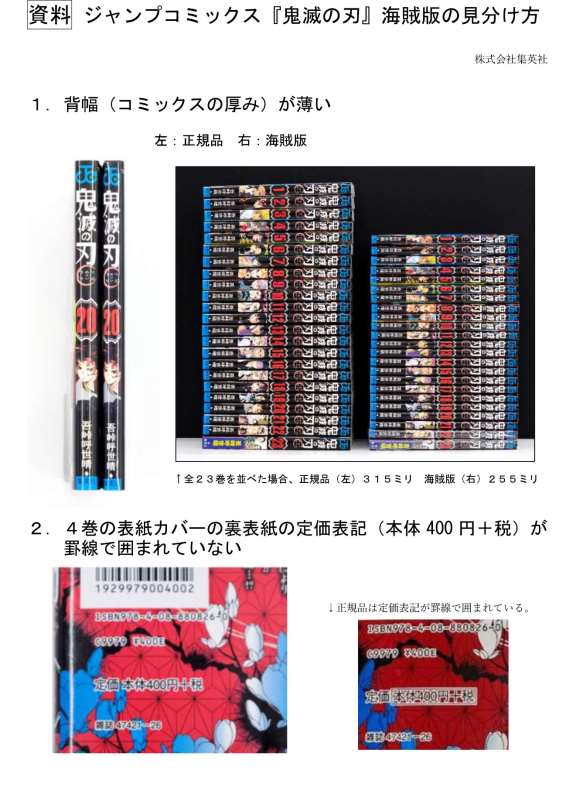
Counterfeiting is not limited to expensive first printings. On 18 February 2021 Shueisha reported pirated sets of all 23 Demon Slayer volumes. Volume 1 in those sets stated “30 June 2020, 39th printing”: these were copies of a later printing. [3]
In the official image, the genuine complete set measures 315 mm against the fake’s 255 mm. The lower comparison shows volume 4’s back cover, where the fake lacks the box around the price. These checks concern those sets; they are neither measurements for an individual volume 1 nor proof of counterfeit first printings.
The comparison published by Shueisha
[3]01 / 01
The Quintessential Quintuplets.
Specifically, volume 0.
For The Quintessential Quintuplets, the report collected by Usagi concerns the promotional volume 0. We do not have the original photographs needed to show you the comparison, so this remains a report for now. The volume 1 in our archive is a different publication. [4]
Check the official versions too: there is the 2019 bonus and the full-colour volume 0 linked to the film’s 2022 home-video release. Before judging a difference, make sure you are comparing the same version. [5] [6]
Other reported titles
Online reports also mention Naruto 1, Bleach 1, Tokyo Ghoul 1 and Attack on Titan 1. We do not yet have verified photographic comparisons to show you for these titles. They remain cases to investigate: if you are considering a purchase, ask for complete photographs of the copy, colophon and interior.
There is also information about Naruto and Attack on Titan in the first-appearance magazine guide. A report about a magazine does not establish that the corresponding tankōbon has also been counterfeited.
What can mislead you
- Glue alone does not identify a fake. Genuine manga can use adhesive binding, including the ajiro process. You need to know how the edition you are checking was bound. [7] [8]
- An ISBN is not the same thing as a barcode. ISBNs changed to 13 digits in 2007, but Japanese book JAN barcodes existed earlier. Counting barcode digits therefore cannot date a book. [9] [10]
- Yellow paper does not certify age. Colour, smell and wear may catch your attention, but they do not settle the check. Lighting also changes the appearance of paper in photographs.
Before buying: photographs to request
- Request photographs of the book you will receive. Front, back and spine, including a dated note identifying the seller. Check that every image shows the same copy.
- Ask to see the jacket opened out. You need its flaps, the bare book and the complete colophon. If an obi is included, request its back, flaps and coupon too.
- Point out the details you want to see. Use this guide’s photographs as examples. Ask for focused, straight-on, unfiltered images; compressed thumbnails often hide the details you need.
- Compare the same edition. A different printing or format may explain differences that would otherwise look suspicious.
- Check again on arrival. The received book should match the listing. Keep the photographs, description and messages if something does not add up.
Still unsure? Bring us the photographs and point to the detail that concerns you. Looking at it together is more useful than a vague “it looks fine”. These are known examples; another counterfeit may not have the same flaws.
Common questions
Do a correct ISBN or date prove authenticity?
No. They can be reproduced with the colophon. Compare printing and construction against the exact edition.
Is an altered copy counterfeit?
Not necessarily. Altered describes interventions; counterfeit describes an unauthorised reproduction. If the jacket or obi has been replaced, check that it belongs to the book’s edition.
Does a slab remove the need for checking?
Always check that the book, label and certification match the offered copy. A certificate number copied into a listing does not establish possession of that copy.
Sources, photographs and method
- [1]1stPrint.net · One Piece 01 ↗
16 photographs; Hosoemon and Usagi credited in the article.
- [2]1stPrint.net · Dragon Ball 01 ↗
21 photographs of copies and details. V1 and V2 are two distinct counterfeits.
- [3]Shueisha · Kimetsu no Yaiba · 18.02.2021 ↗
Official notice, pp. 1–2; comparison image on p. 2.
- [4]Usagi · Hosoemon · The Quintessential Quintuplets 0 ↗
Collection referring to the 26 May 2022 report. Original images not verified here.
- [5]TBS · The Quintessential Quintuplets · 2019 ↗
Official announcement of volume 0 as a home-video bonus.
- [6]TBS · The Quintessential Quintuplets Movie · 2022 ↗
Official full-colour edition of volume 0.
- [7]Inshokan · Ryūjo Senki ↗
Printer’s example of a genuine manga using ajiro binding.
- [8]Kominike · Publishing glossary ↗
Definition of adhesive ajiro binding.
- [9]International ISBN Agency · What is an ISBN? ↗
13-digit ISBNs from January 2007.
- [10]GS1 Japan · JAN code history ↗
Introduction of book JAN codes in 1990.
1stPrint articles and annotations reviewed on 16 October 2026. Each image’s text was transcribed and checked against its explanation. Where English prose sits outside the photograph, the article view excludes it; labels, arrows and details remain visible. “Open full photograph” always shows the complete original. Real means genuine and Fake means counterfeit, as identified by the credited author. The FAKE-stamped cover is an editorial illustration created with AI; the comparisons are real photographs.