
Altered manga: the grade does not tell the whole story
Read alteration notes on BGS manga labels: eight photographic examples, complete label wording and real sales to understand the effect on price.
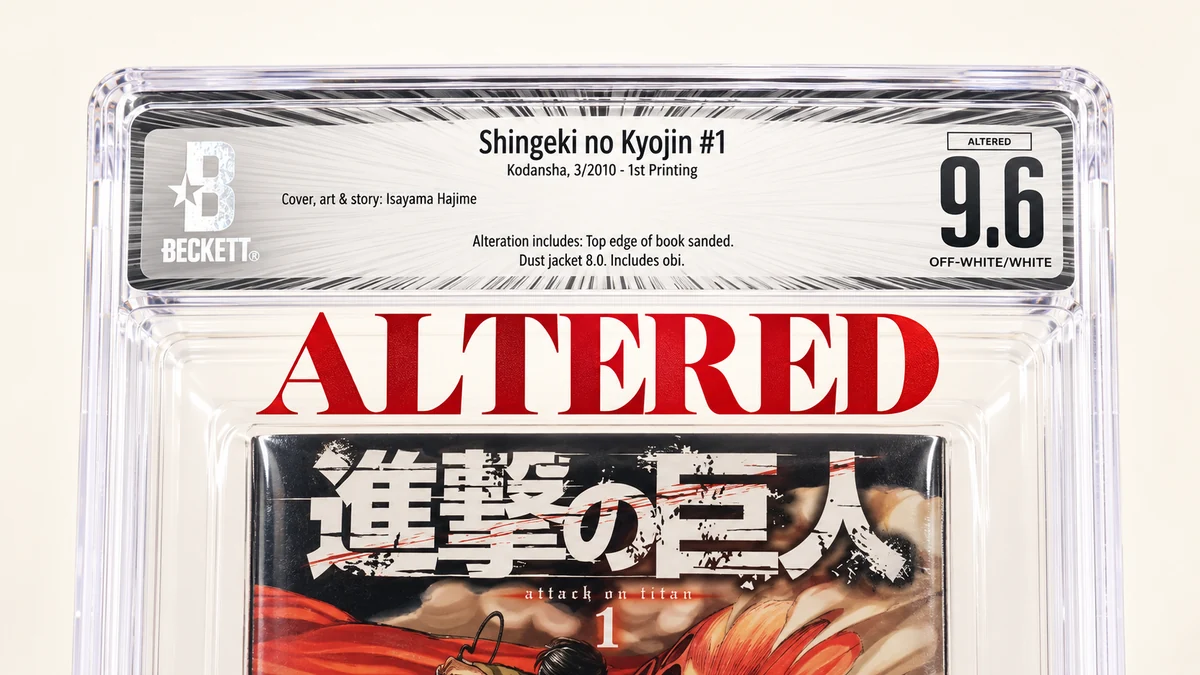
A few extra points.
And the temptation to chase them.
When you start looking for graded manga, you soon notice that even a small increase in grade can make a large difference to the price of the same volume. That can be especially noticeable at the top of the scale, where exceptional copies become harder to find. Prices do not follow a fixed formula, though: title, printing, demand and the individual copy still matter.
It is easy to think: “If I could remove that mark or brighten that edge, perhaps it would get a higher grade.” This is the moment to pause. A treatment can make a book look better while reducing its originality and collectible value. Abrading paper, trimming a margin or attempting to clean a surface can cause irreversible changes.
BGS examines a manga’s authenticity and physical condition. The labels below show how specific intervention notes can be, from a sanded edge to pages reattached with glue. Do not assume that a treatment will go unnoticed. And not every intervention was intended to deceive a grader: some are old repairs made long before anyone considered encapsulation. [1]
Altered does not automatically mean counterfeit. It may be an authentic manga that someone has worked on. The useful question is: what was changed, and how much does it matter to the copy I want to buy?
The large number first.
Then every word of the small print.
Always enlarge the label. A full-slab photograph viewed on a phone can leave the wording almost unreadable. The intervention may be absent from the listing title or description.
- In the centre of the label, near the dust jacket grade and any obi information, look for the complete intervention note.
- Above the numerical grade, on the right, the photographs below may show a small box marked ALTERED, CONSERVED, RESTORED or MARRIED.
Looking for a single word is not enough. The tape example has no such box, yet the notes still describe a repair.
The numerical grade remains clearly visible on the treated copies shown here. A 9.6 with an alteration note should therefore not be compared blindly with a 9.6 without a reported intervention.
- Altered
- Signals an alteration. Read the accompanying wording to find out what it was.
- Conserved
- Refers to conservation or repair, not simply a well-preserved book. Our examples also say Amateur; that qualification matters.
- Restored
- Identifies restoration. The note tells you what was treated; the word alone does not describe the whole job.
- Married
- Identifies components brought together from different copies. Read which parts are named rather than extending the note to other components.
These words are not interchangeable. In Graded prices, Altered is our umbrella filter for recorded interventions, with the type retained in the details. That is a database grouping, not a claim that every label literally says “ALTERED”.
If you collect trading cards
This distinction may surprise you. Under PSA and CGC Cards rules, some alterations lead to outcomes such as Authentic Altered instead of the normal numerical grade; historical BGS card submission forms also make this distinction. The manga slabs photographed here retain a number alongside the intervention note. The grade does not erase the intervention. Nor does an alteration necessarily eliminate a market: a copy can still appeal to collectors, but it needs to be assessed for what it is. [2–4]
Eight interventions.
Eight labels to read together.
Each example includes the original photograph and the complete central BGS note, including the dust jacket grade and any obi statement. Beside it, we explain what the wording means for that copy. Open any photograph to zoom in: we have not redrawn or corrected its label.
A useful distinction: the book’s three page edges are the top, bottom and outer surfaces formed by the pages when the book is closed. They are not the spine.
Sanding · abraded page edges
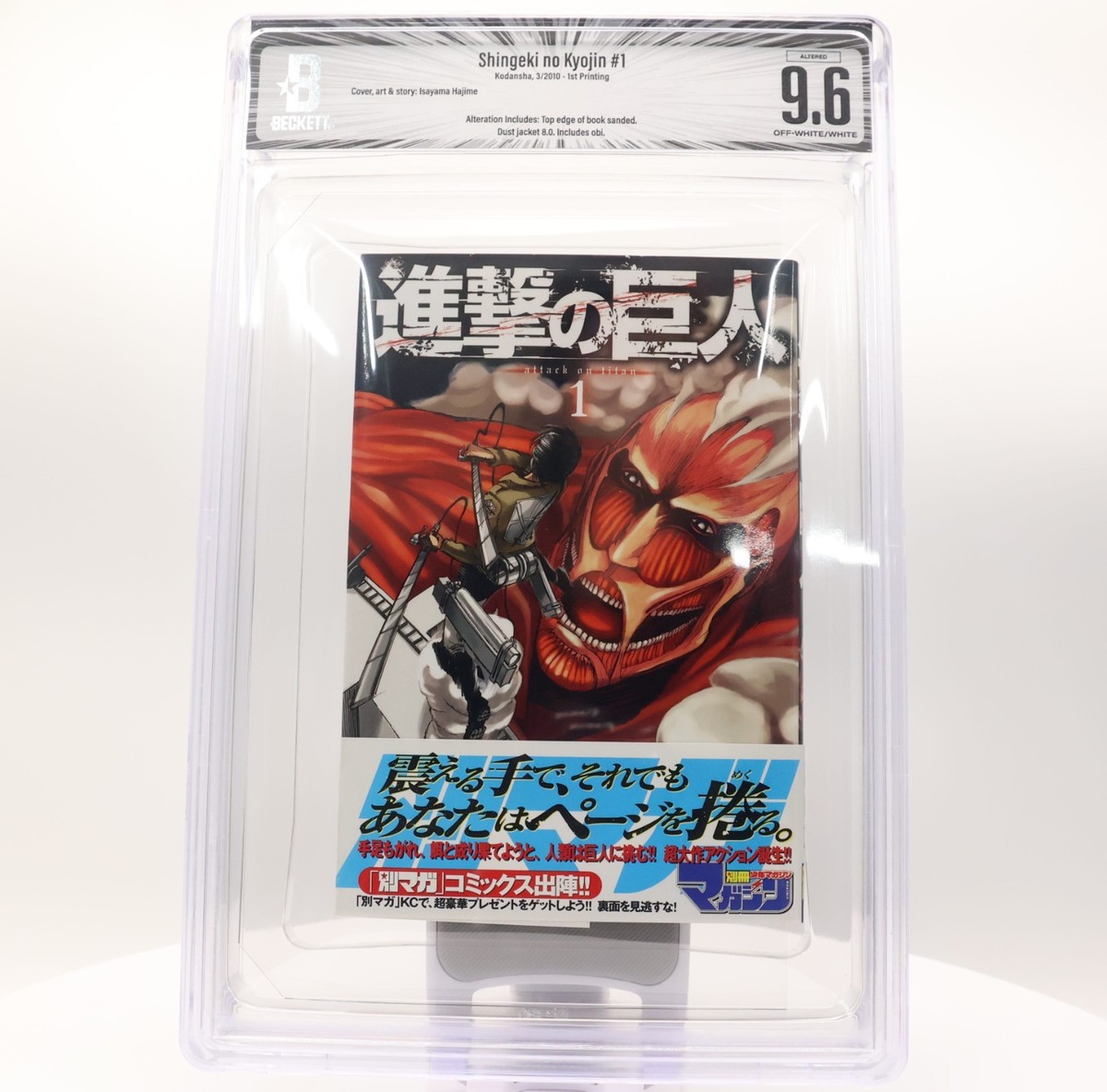
Alteration Includes: Top edge of book sanded.
Dust jacket 8.0. Includes obi.Photograph source [7]Sanded means that a surface has been abraded. This may make a book’s edge look more even or lighter, but removes original material. Here BGS names only the top edge, not every edge and not a generic cleaning treatment.
Look at the number: this Attack on Titan received 9.6, with an 8.0 dust jacket and an obi included. “ALTERED” appears above the grade. This is exactly why the large number is not enough: a high grade and an alteration appear on the same label.
What to remember: a very bright edge does not, by itself, prove exceptional preservation. Read the note and ask for close-up photographs of the page edges.
Machine polishing · mechanically treated edges
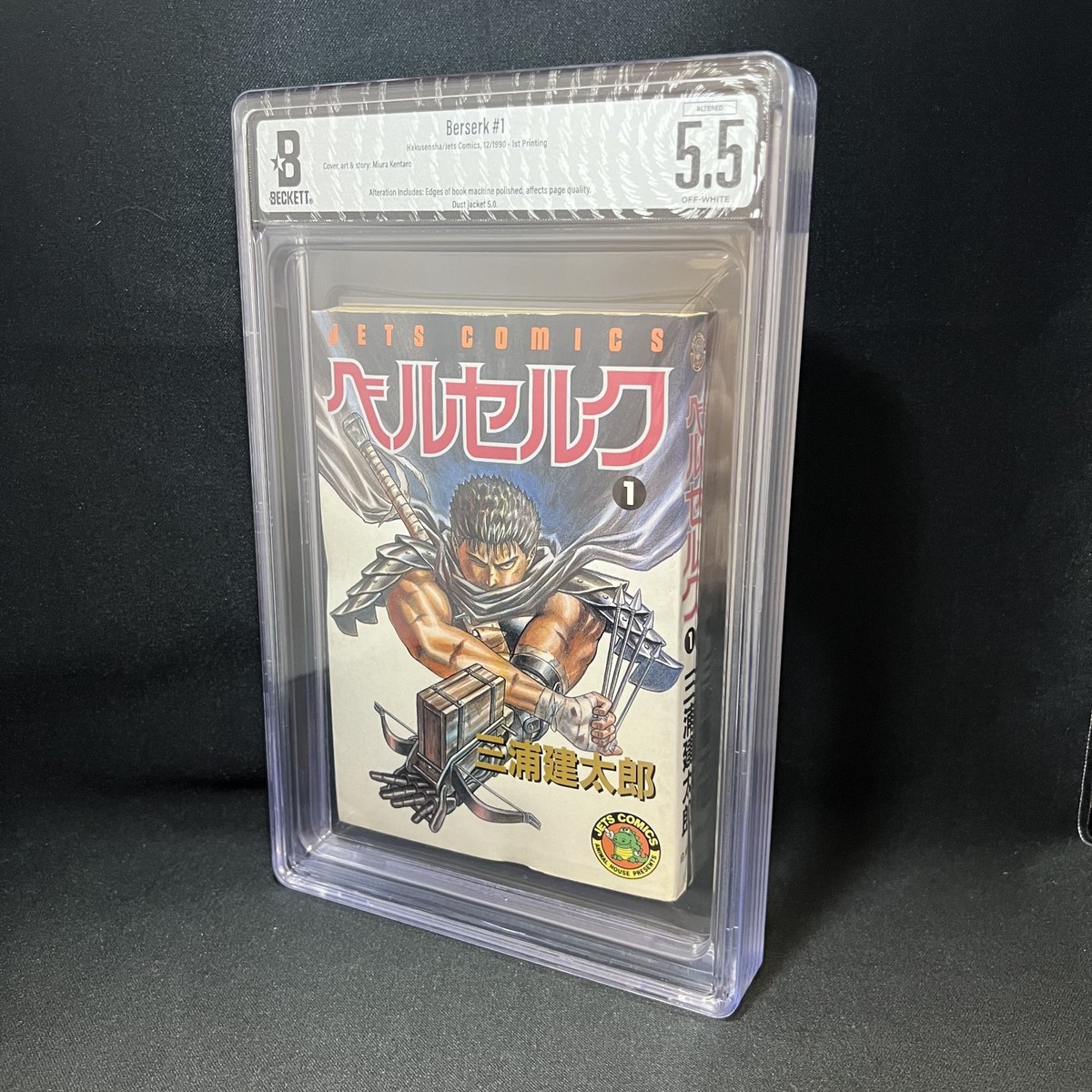
Alteration Includes: Edges of book machine polished, affects page quality.
Dust jacket 5.0.Photograph source [8]This note describes mechanical treatment of the book’s page edges, not polishing of the slab’s plastic. It includes a detail worth reading carefully: “affects page quality”.
This Berserk has a 5.5 book grade, a 5.0 dust jacket and an “ALTERED” classification. BGS does not identify the machine, abrasive or procedure. We cannot reconstruct those from the photograph, so we retain machine polished rather than replacing it with sanded.
What to remember: read the second half of the sentence too. This note records both treatment of the edges and an effect on page quality.
Cleaning · cover and dust jacket
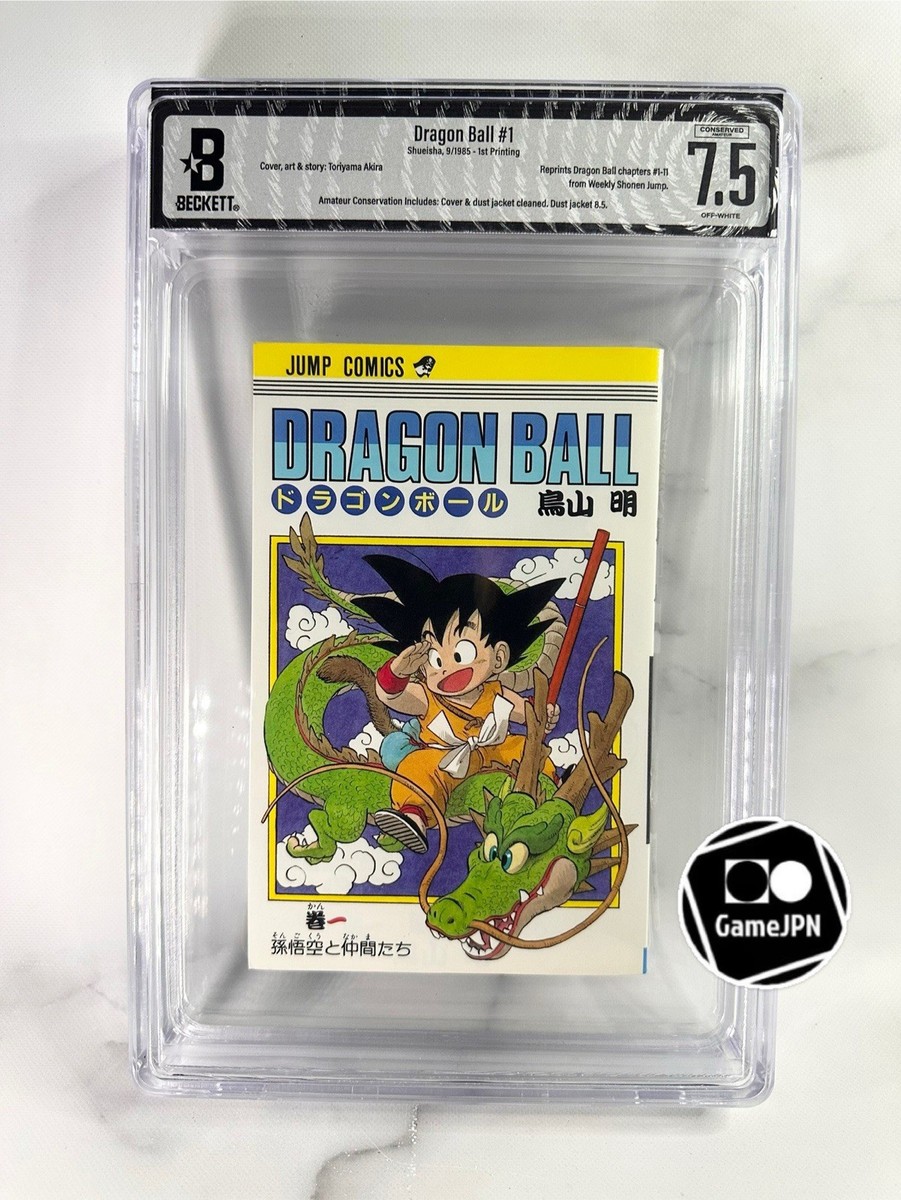
Amateur Conservation Includes: Cover & dust jacket cleaned. Dust jacket 8.5.Photograph source [9]“It was only cleaned” can sound reassuring. This label shows why it is worth asking more. BGS identifies amateur conservation and names two separate parts: the book’s cover and its outer dust jacket.
The book is graded 7.5 and the dust jacket 8.5. Cleaned does not tell us which products were used or whether the process was dry or wet. We cannot fill that gap ourselves. This one example also does not establish that every instance of dust removal receives the same classification.
What to remember: “CONSERVED” does not mean “well kept”. Here it records a treatment, qualified as “AMATEUR”, which belongs in your price comparison.
Glue repair · reattached spine and pages
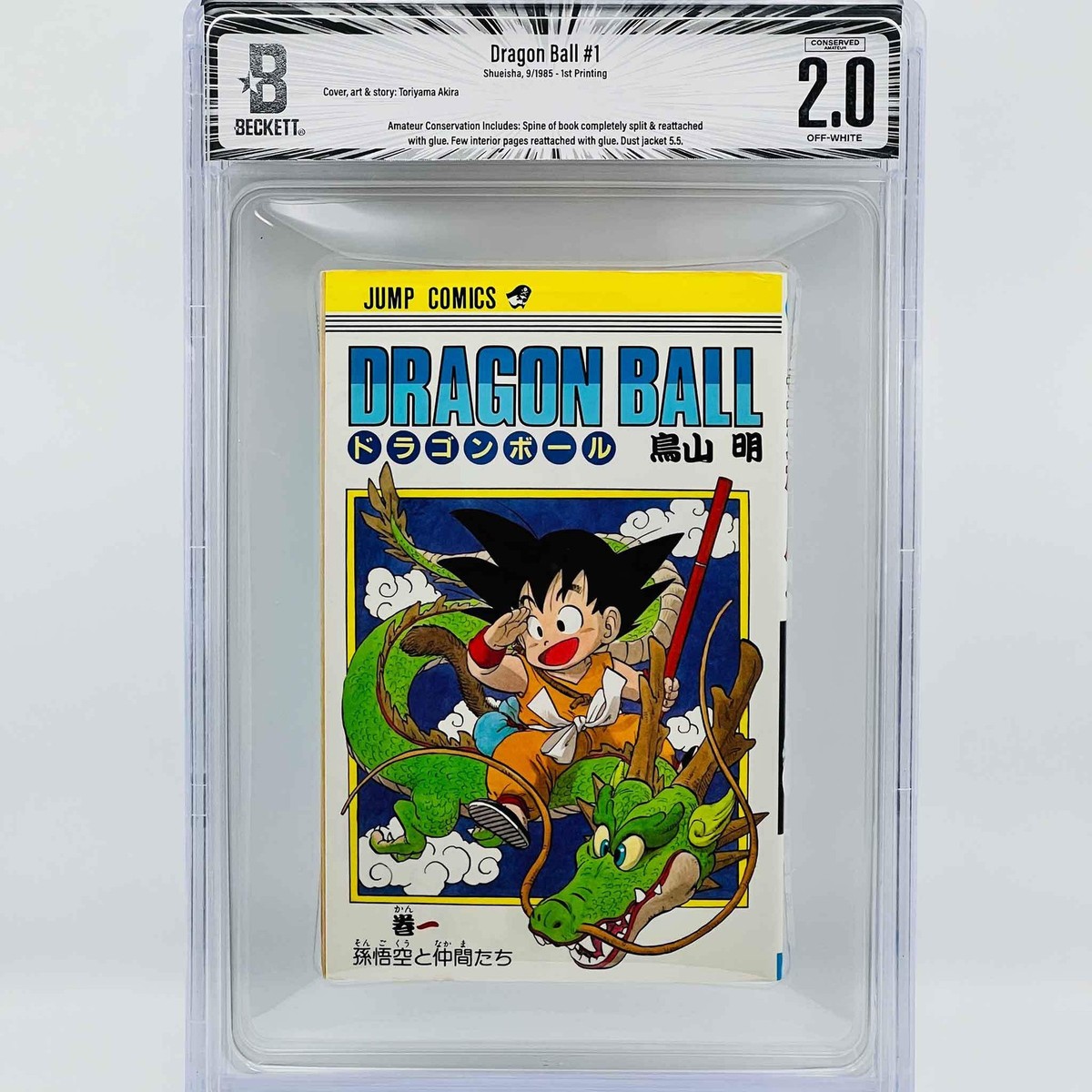
Amateur Conservation Includes: Spine of book completely split & reattached
with glue. Few interior pages reattached with glue. Dust jacket 5.5.Photograph source [10]Read the whole sentence: it describes two repairs. The spine was completely split and reattached with glue; a few interior pages were also reattached with glue. Reducing this to “glue present” would miss the important information.
This Dragon Ball is classified “CONSERVED / AMATEUR”, with a 2.0 book grade and a 5.5 dust jacket. The book was originally produced with an adhesive binding; the note concerns later repairs, not ordinary manufacturing glue.
What to remember: an attractive dust jacket can surround a much more damaged book. Read its grade separately from the condition of the book itself.
Tape repair · adhesive tape and reinforcement
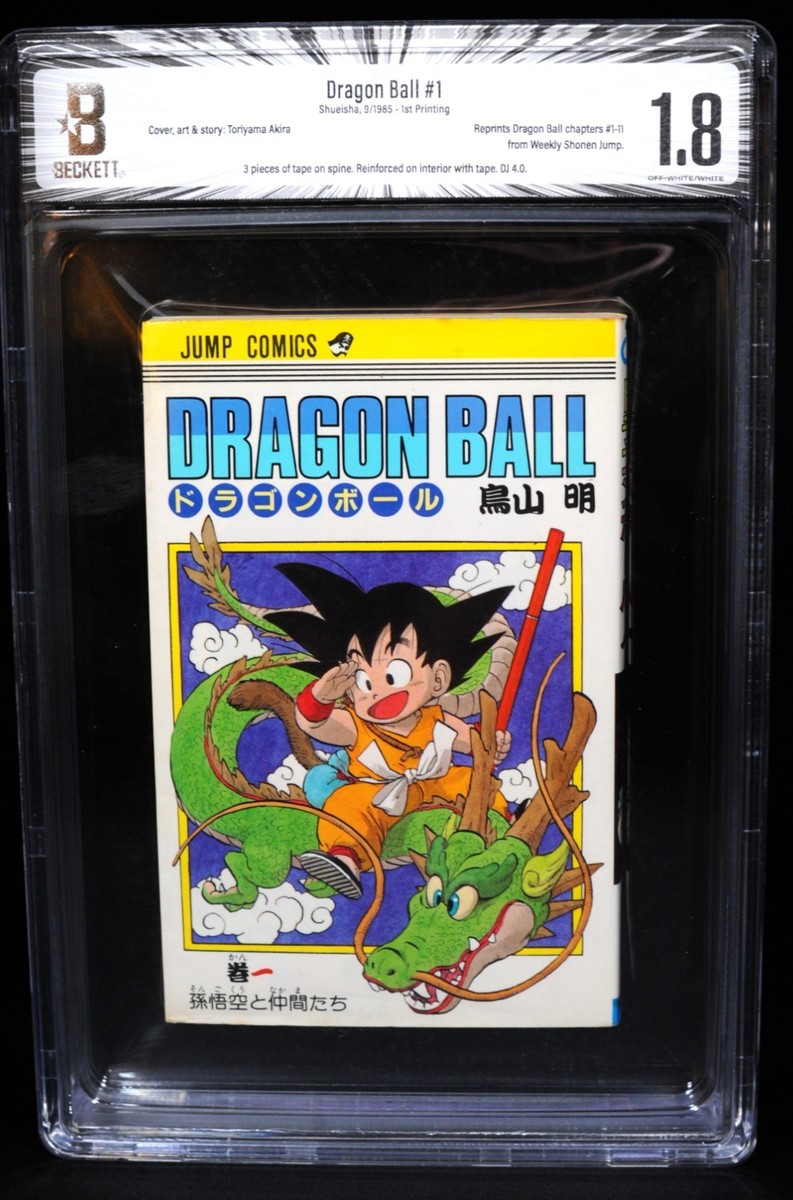
3 pieces of tape on spine. Reinforced on interior with tape. DJ 4.0.Photograph source [11]BGS counts three pieces of tape on the spine and records interior reinforcement with tape. It does not specify the product or when the repair took place. This is information about the book’s condition, even when the numerical grade is already low.
The book is graded 1.8 and the dust jacket 4.0. Look at the photograph: there is no “ALTERED” box above the grade. Adding one in our description would be inaccurate. Our database still groups this recorded intervention under the Altered filter, with its type identified.
What to remember: the absence of the word “ALTERED” is no substitute for reading the notes. A repair may be disclosed in an ordinary sentence.
Lightening · lightened page edges
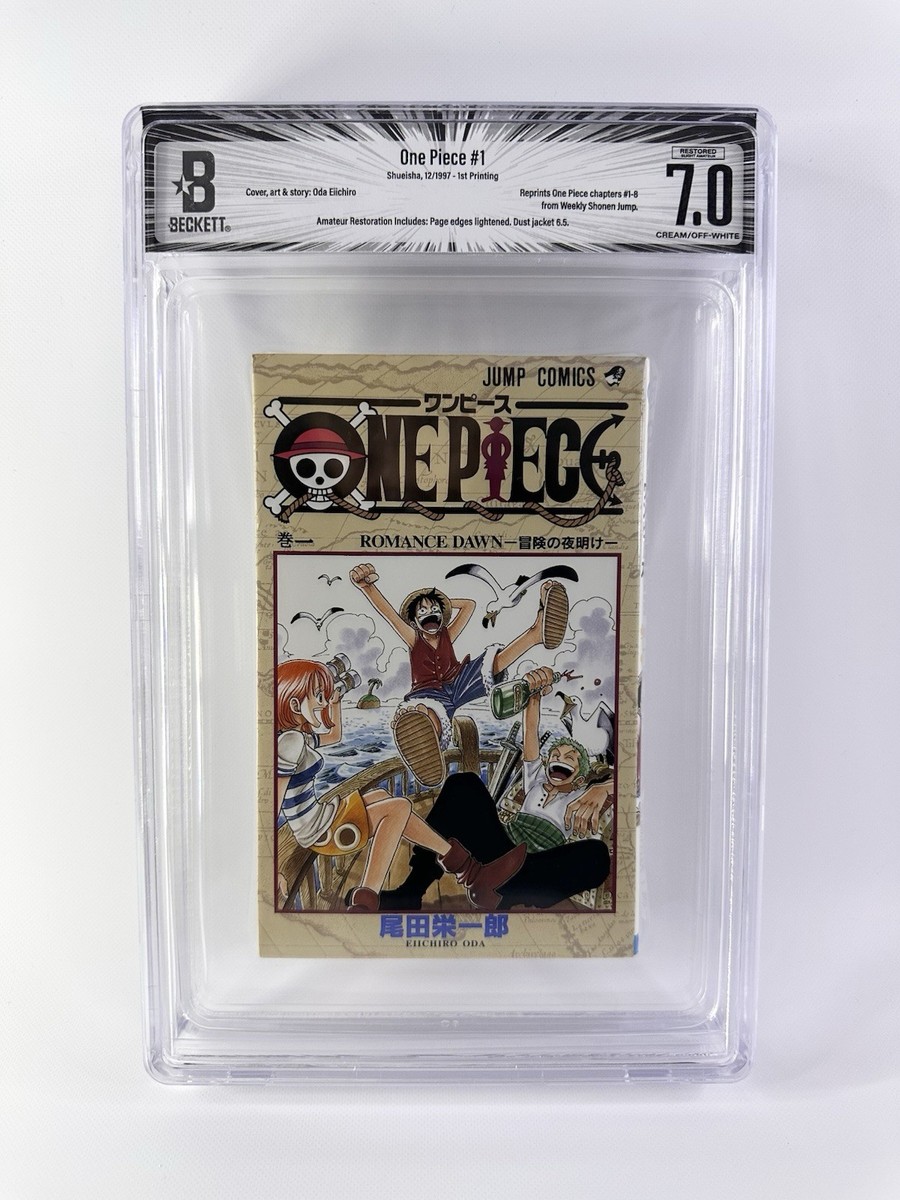
Amateur Restoration Includes: Page edges lightened. Dust jacket 6.5.Photograph source [12]Lightened means that the page edges have been made lighter. The result may make a book look less yellowed, but it is not the same as paper that remained naturally lighter over time.
On this One Piece, BGS writes “Amateur Restoration” and displays “RESTORED”: the book is 7.0 and the dust jacket 6.5. Page quality is still recorded as “CREAM/OFF-WHITE”. The note does not identify the method. Naming bleach, another chemical or UV treatment as a certainty would add information that is not there.
What to remember: read page colour and treatment notes together. A bright photograph alone cannot tell you how the paper acquired its appearance.
Trimming · a recut cover edge
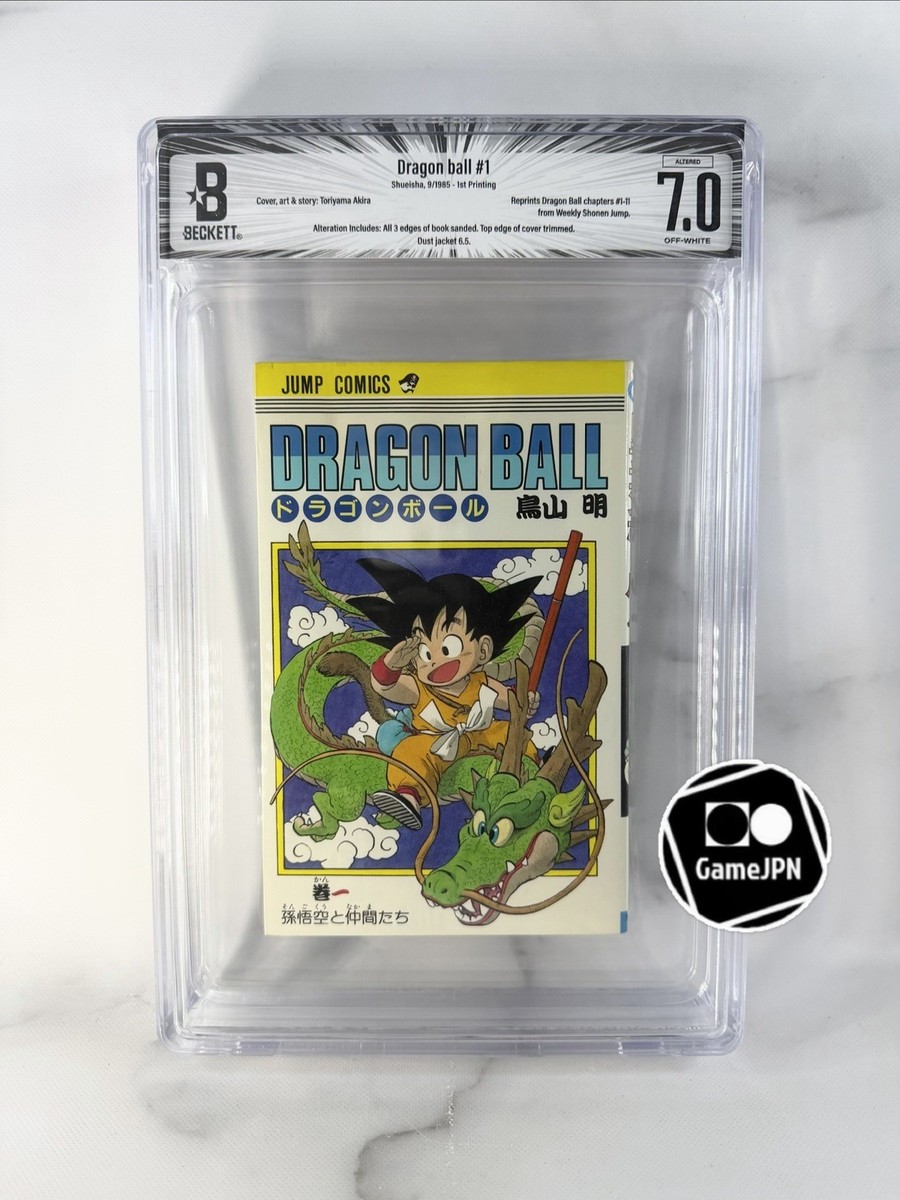
Alteration Includes: All 3 edges of book sanded. Top edge of cover trimmed.
Dust jacket 6.5.Photograph source [13]Trimming means recutting a margin and removing some material. It differs from sanding, which abrades a surface. Here BGS records both interventions: all three page edges were sanded, while the top edge of the cover was trimmed.
The distinction matters. The note says cover, not dust jacket, and does not say that all the pages were trimmed. This Dragon Ball has a 7.0 book grade, a 6.5 dust jacket and an “ALTERED” classification. [5–6]
What to remember: identify the exact part BGS names. “Modified edges” is too vague to explain what you are buying.
Married · components from different copies
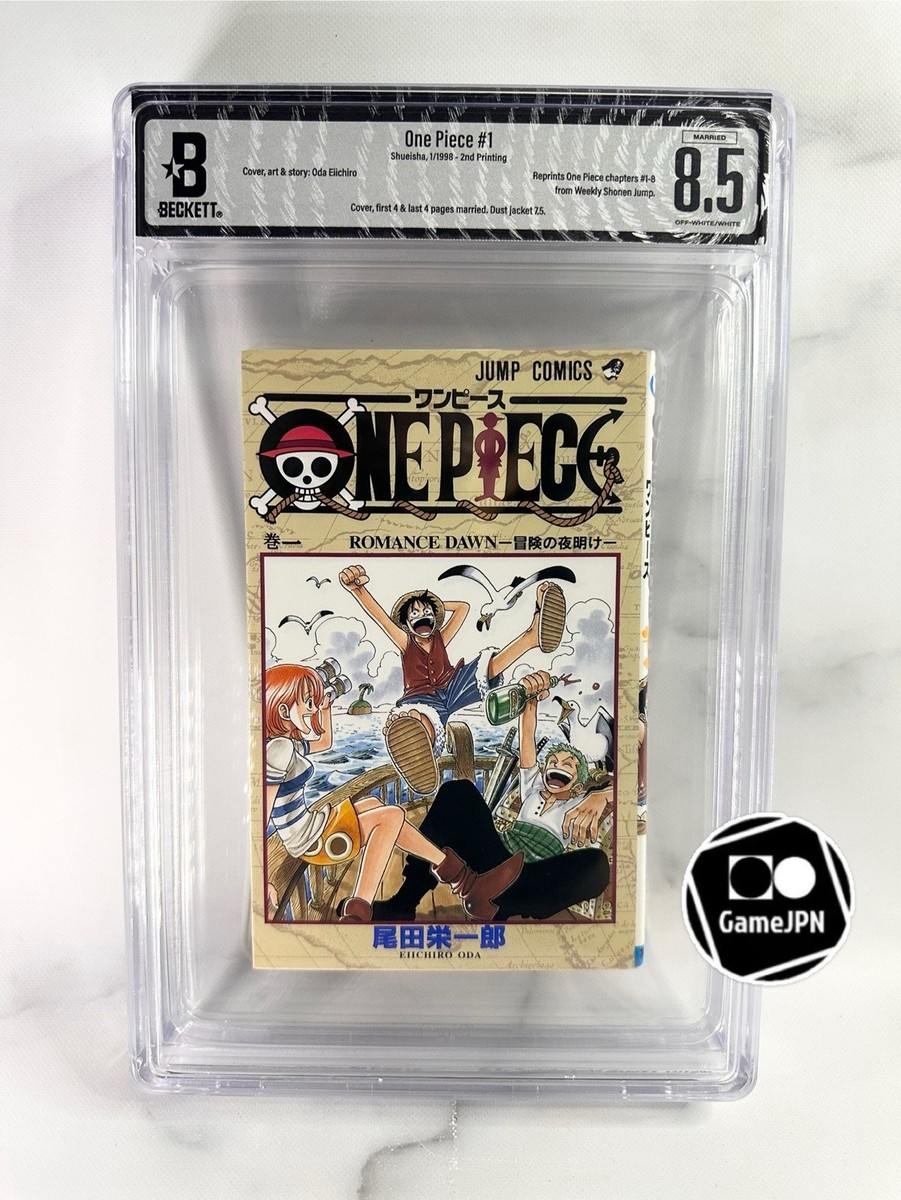
Cover, first 4 & last 4 pages married. Dust jacket 7.5.Photograph source [14]This example is about more than a treated surface: it concerns how the copy is assembled. Married identifies components from different copies brought together in one book. The note names the cover, first four pages and last four pages. It does not mention an added obi or attribute the intervention to the dust jacket.
The book is graded 8.5 and the dust jacket 7.5. There is another important detail: this is the January 1998 second printing, not the December 1997 first printing. We use it to illustrate the intervention, not as a first-print price comparison.
What to remember: authentic parts can have been assembled later. Check both the copy’s composition and the printing recorded on the slab.
Eight examples, not every possible intervention
Comic restoration terminology also includes colour touch, replacement of missing material and other reinforcement. The CGC sources below help explain the vocabulary, but their classifications should not automatically be applied to BGS manga. For these examples, we started with the notes actually readable in the photographs. [5–6]
There can still be a market.
At a very different price.
An altered copy may still appeal to you: it could be a favourite title, a hard-to-find book or a way to collect within a different budget. What matters is knowing what you are buying. The same grade does not make two copies equivalent when one has been treated.
Below is a real Yu-Gi-Oh! 1 comparison: the same book grade, dust jacket grade and page colour, no obi, and auction sales. The panel reads our database directly, so amounts, sample sizes, dates and the percentage difference update with the available data.
The gap can be substantial. It is a difference observed in sales, not a fixed loss applying to every altered copy. The type of intervention matters, as do details a grade alone cannot capture.
Try it with the volume you collect
Choose a title in Graded prices, compare Altered with Not altered, then match the book grade, dust jacket, obi, pages and period as closely as possible. Open the sale details to read the recorded intervention. With only one sale in each group, you are comparing two individual copies: useful evidence, not a certain valuation.
Before buying.
Or trying to “improve” your own manga.
- Ask for a sharp photograph of the whole label. If the small print is unreadable, pause and request another image.
- Read title, printing and notes together. Check the certification number, book grade, jacket, obi and page quality. A later printing remains a later printing inside a slab.
- Name the intervention precisely. What was done, and to which part? If the note does not state the method, do not infer it from a photograph’s colour.
- Compare genuinely similar copies. Look at completed sales, dates and sample sizes, not just a listing’s asking price.
- Before treating your own copy, consider what you could lose. A bid for a slightly higher grade can leave a permanent change. If a book needs repair to survive, consult a qualified conservator and retain documentation of the work.
Our Not altered filter contains copies with no intervention identified in the available review. It is not a promise that a photograph can reveal every treatment. If you are unsure, bring readable photographs to the community. That is where a useful discussion starts.
Questions collectors often ask
Is altered manga counterfeit?
Not necessarily. An authentic book may have been sanded, trimmed or repaired. Authenticity and the absence of modifications are separate questions.
Why can altered manga have a high grade?
On the slabs shown here, BGS records a numerical grade alongside the classification and intervention notes. Read them together: the number does not make the copy equivalent to an untreated example with the same grade.
Does Conserved mean the manga was well preserved?
No. In these examples it identifies conservation or repair, also qualified as Amateur. The complete note explains the treatment.
How much value does altered manga lose?
There is no fixed percentage. Comparable sales can show very large gaps, but title, intervention, condition, demand and period matter. The percentage in this guide is calculated from observed sales, not a prediction for every copy.
Is every cleaning treatment classified as Altered?
This guide does not make that claim. The photographed slab records cover and dust jacket cleaning as Amateur Conservation. Cleaned alone does not identify products or technique and does not classify every other cleaning treatment.
Can one book have several interventions?
Yes. The Dragon Ball in the trimming section also has sanding on all three edges. A copy can therefore appear under multiple intervention types in the database.
Sources and photographs
Reviewed on 16 October 2026. All eight central notes were transcribed and checked against the original, unretouched photographs. Translations and explanations are ours. We did not find a complete public BGS manga glossary of interventions: the examples are based on the labels, while other sources clarify terminology and differences between services.
Beckett pages were intermittently accessible during review. We consulted indexed official content for the service description and historical form; the photographed wording is the evidence for each individual manga treatment.
- [1]Beckett — Manga Grading ↗
Service, physical assessment, numerical grade and page quality.
- [2]PSA — Grading Standards ↗
Ungradable Cards and No Grade Definitions: alterations and Authentic Altered outcomes for cards.
- [3]CGC Cards — Grading Scale ↗
Designations section: Authentic Altered in the grade field.
- [4]Beckett — BGS Gaming Submission Form ↗
Historical card submission form, not current manga rules.
- [5]CGC Comics — An Overview of Comic Book Restoration ↗
Restoration and conservation vocabulary; CGC criteria are separate from BGS manga criteria.
- [6]CGC Comics — Glossary ↗
Terminology including cleaning and cover trimmed.
- [7] · PhotographShingeki no Kyojin #1 · Sanding
Original listing ↗ · eBay image source ↗ · Preserved original ↗
- [8] · PhotographBerserk #1 · Machine polishing
Original listing ↗ · eBay image source ↗ · Preserved original ↗
- [9] · PhotographDragon Ball #1 · Cleaning
- [10] · PhotographDragon Ball #1 · Glue repair
Original listing ↗ · eBay image source ↗ · Preserved original ↗
- [11] · PhotographDragon Ball #1 · Tape repair
- [12] · PhotographOne Piece #1 · Lightening
Original listing ↗ · eBay image source ↗ · Preserved original ↗
- [13] · PhotographDragon ball #1 · Trimming
Original listing ↗ · eBay image source ↗ · Preserved original ↗
- [14] · PhotographOne Piece #1 · Married
These examples do not measure how common alterations are across the market. The illustrated cover is separate from the photographic evidence. Example photographs retain any original writing and watermarks.