
Weekly Shōnen Jump reprints: rear marks, photographs and 2017 packs
How to distinguish official reprints from period issues: One Piece, JoJo and Dragon Ball photographs, the 復刻版 mark and the three 2017 packs.
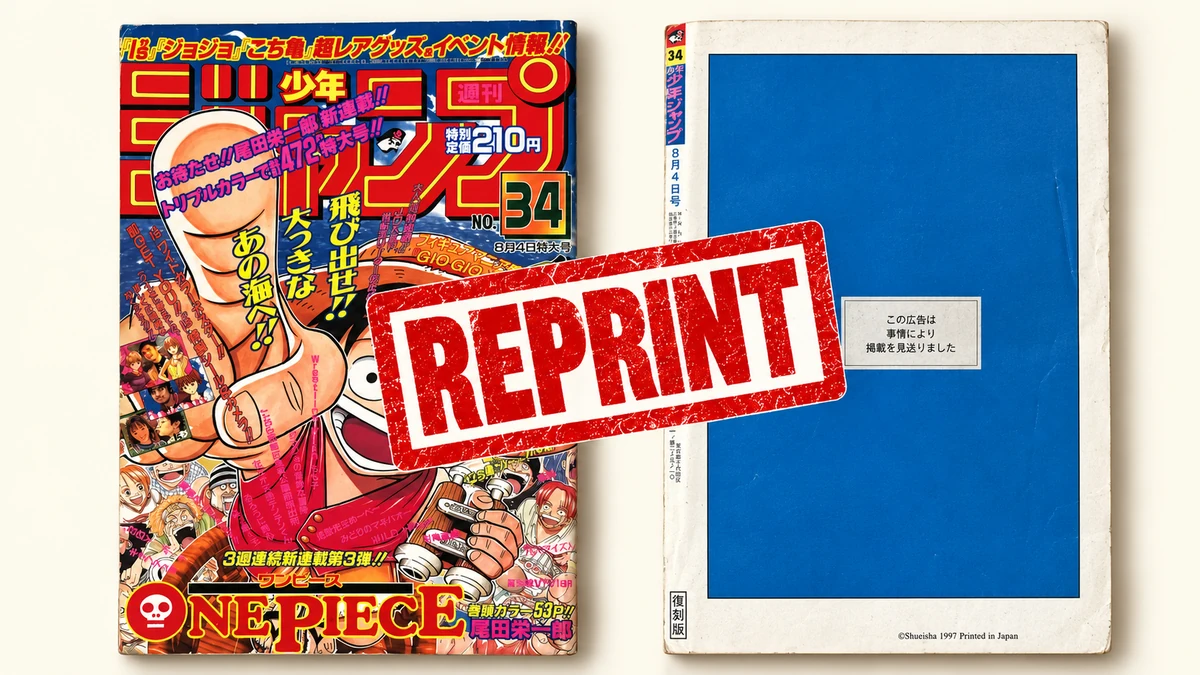
How to distinguish a period Jump from the commemorative reprint
This guide starts with a community question: how can you recognise a reprint of Weekly Shōnen Jump issue 34 from 1997, where One Piece debuted? The most useful check is on the back. It helps to understand the whole initiative: in 2017 Shueisha reproduced six historical issues in three packs.
A period original is the issue published in its historical year; an official reprint, or facsimile, is Shueisha’s authorised later reproduction. A counterfeit is an unauthorised reproduction. Identify which object you are looking at before comparing condition and price.
The 復刻版 mark is at the bottom left of the back cover
Always request a complete photograph of the back cover. All six issues in the three commemorative packs carry the small vertical 復刻版 mark at the bottom left. Read fukkokuban, it identifies a facsimile reprint.
One Piece and Hokuto no Ken have a blue background replacing the advertisement. JoJo and Dragon Ball retain advertising on the back. Blue is therefore not a shared feature: the presence of an advertisement does not establish that a copy is a period original.
One Piece 1997 issue 34: a blue panel replaces the advertisement
The Pack 2 facsimile has a clear difference: it does not reproduce the 1997 edition’s Kirin advertisement. These photographs show the two designs; comparing cover designs does not replace checking the whole copy.
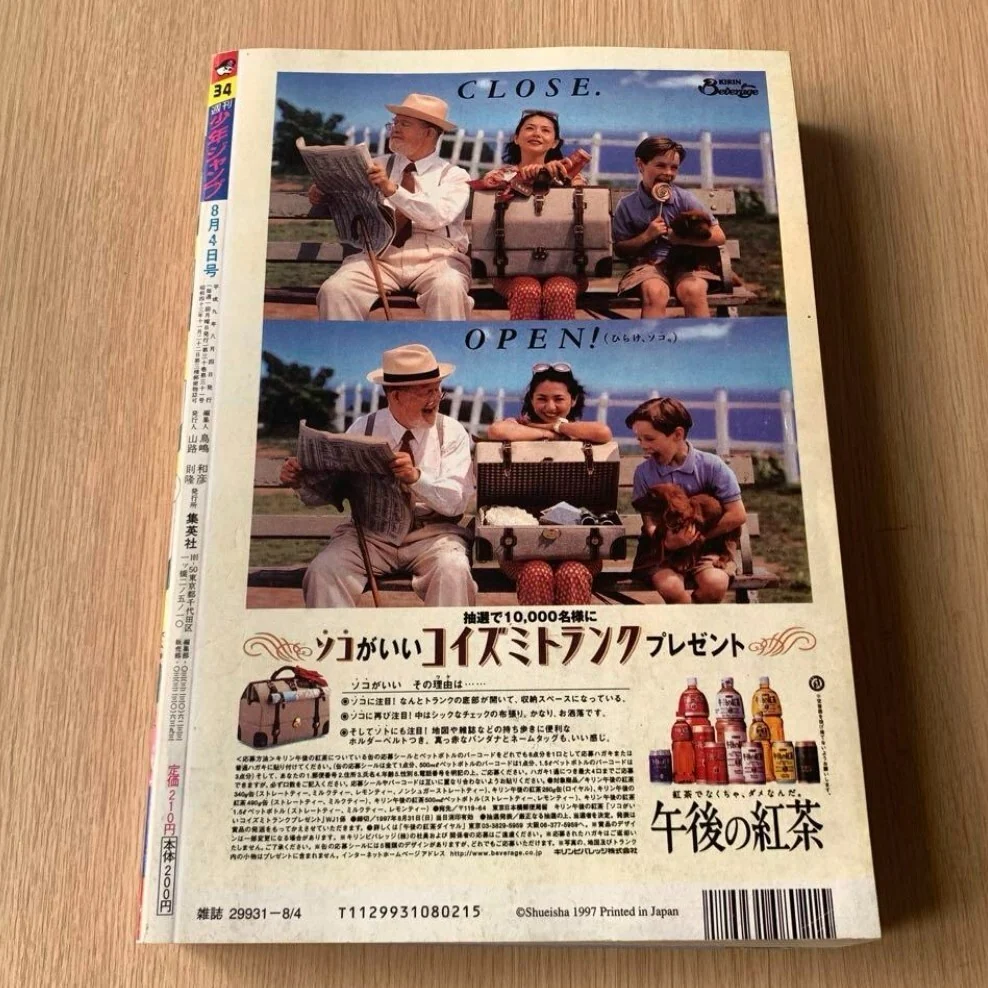
The reference rear for the original shows a Kirin tea advertisement and a barcode at the bottom right.
Comparison photograph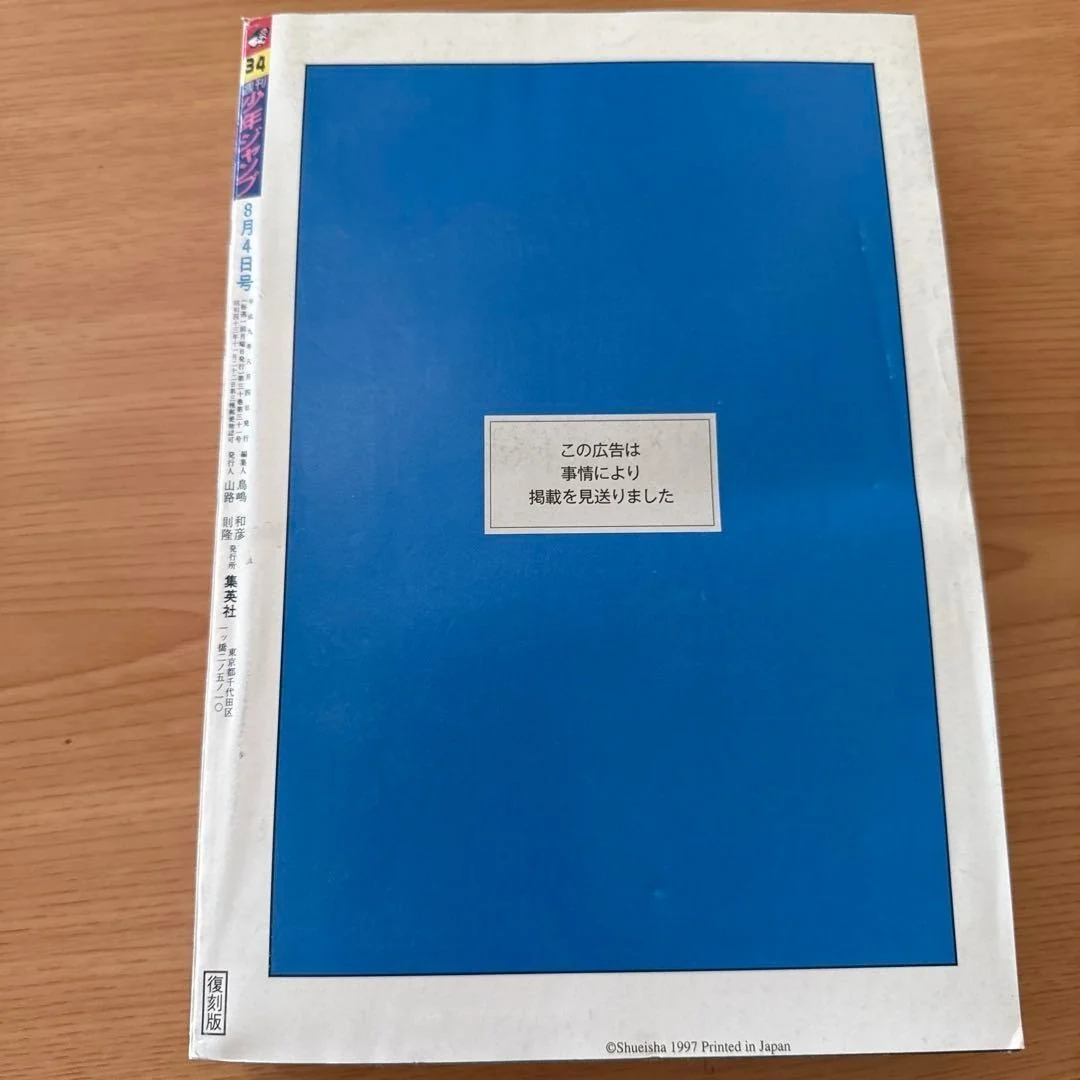
A blue panel replaces the advertisement. Look for the 復刻版 mark at the bottom left.
Comparison photographThe notice on the blue panel, この広告は事情により掲載を見送りました, says that the advertisement was omitted due to circumstances, without specifying why. The 復刻版 mark is separate from that notice: it is the small vertical box beside the spine.
JoJo and Dragon Ball: the reprints still have advertisements
These examples explain why looking for a blue back is insufficient. JoJo retains Bandai’s Pocketzaurus advertisement; Dragon Ball retains a Bridgestone bicycle advertisement. Both photographed copies are reprints and carry 復刻版.
The arrows and red boxes added to the photographs identify the area to check; they are not printed on the magazines. Tap each image to read the mark. If a seller’s photograph crops out this corner, request a complete view before identifying the edition.
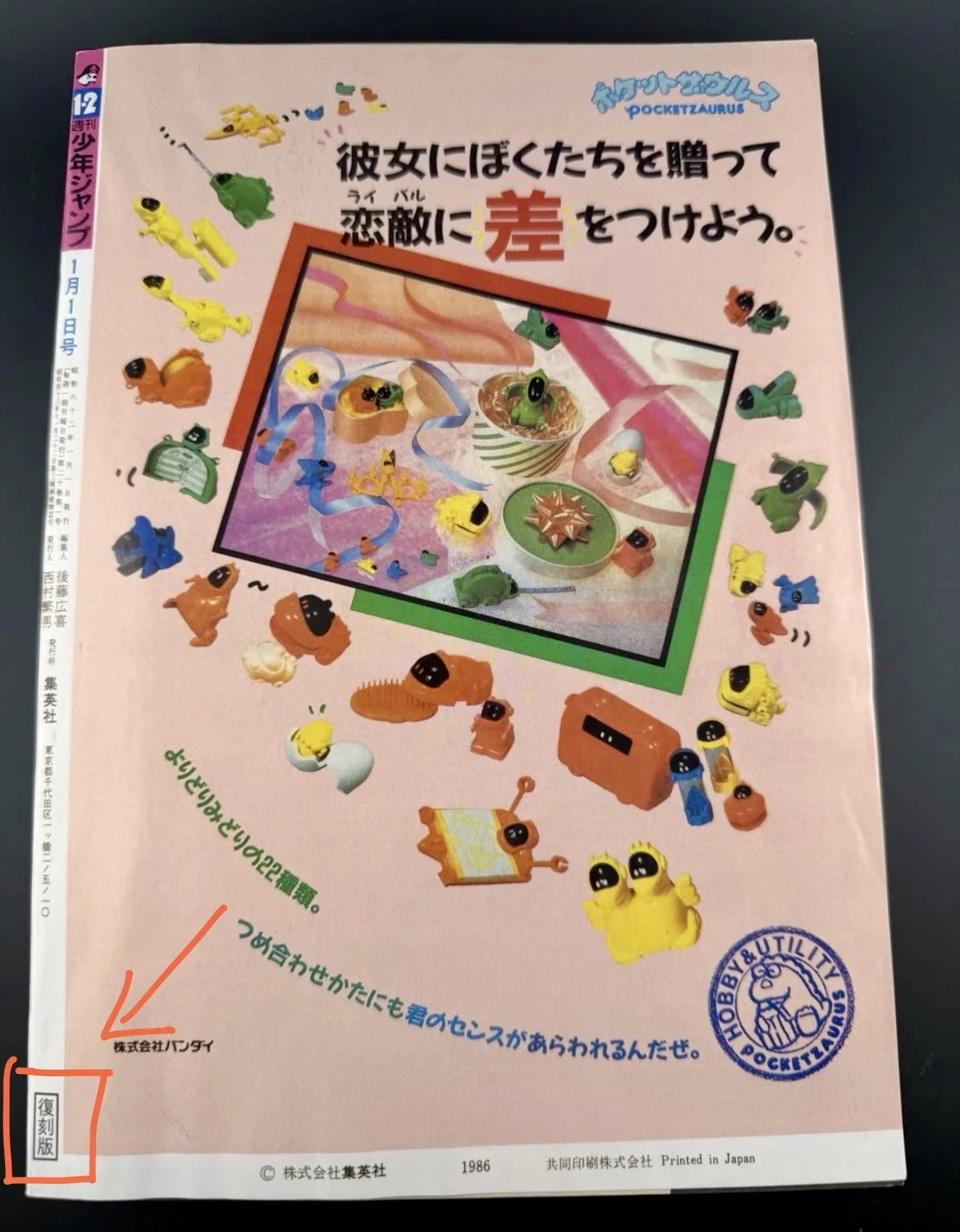
The Bandai advertisement is present. The red box highlights 復刻版 at the bottom left. The reproduced 1986 copyright is not this copy’s printing date.
Community photograph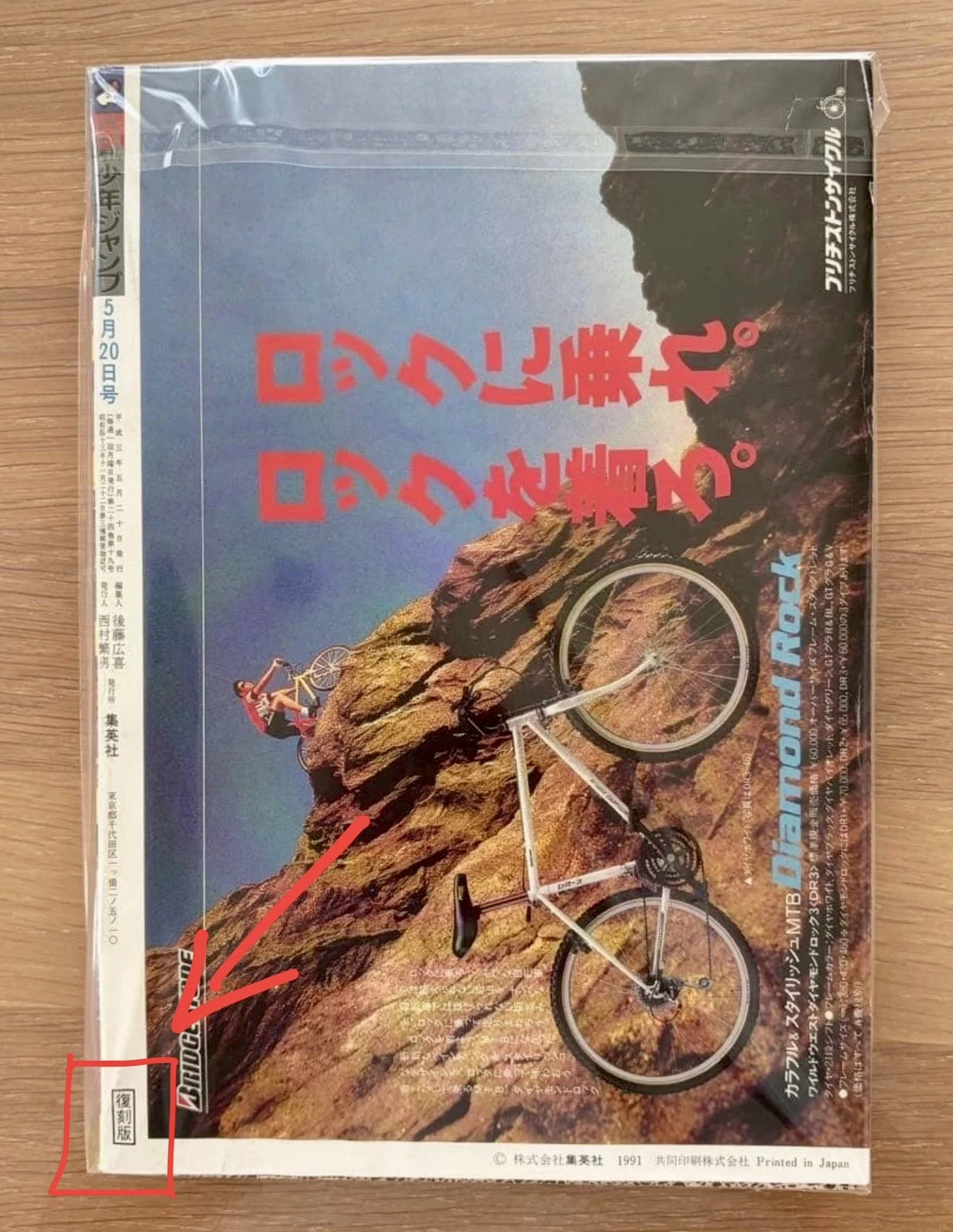
This rear also retains an advertisement. The arrow and red box point to 復刻版; the reproduced 1991 date at the bottom does not make the copy a period original.
Community photographReproduced covers, prices and copyrights do not date the copy
A facsimile recreates an earlier edition: its issue number, cover date, price and copyright can match the original. The 1997 on One Piece, 1986 on JoJo’s rear and 1991 on Dragon Ball do not establish when the photographed copy was printed.
For One Piece, the unbanded front alone provides no verified distinguishing feature in this comparison. Yellowing and cover colour are not proof either: condition, lighting and photography affect their appearance.
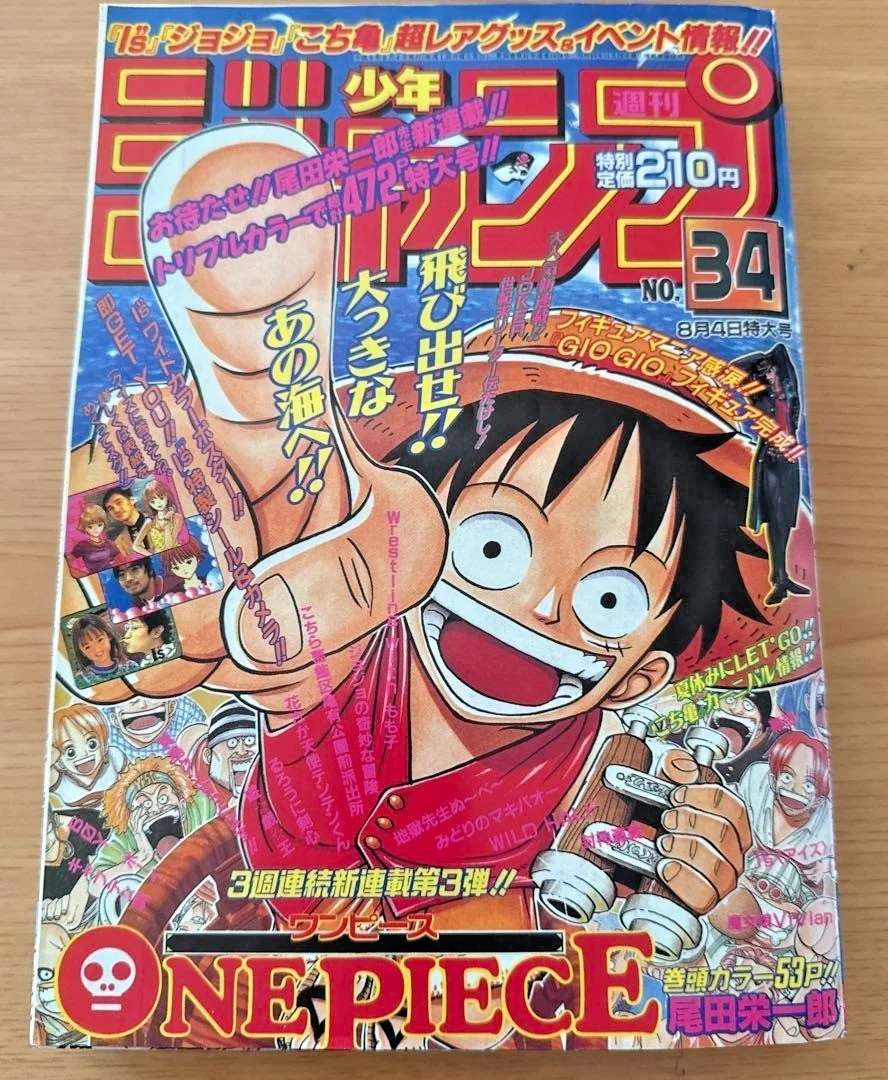
Issue 34, the 4 August date and 210-yen price reproduce the historical cover.
Comparison photograph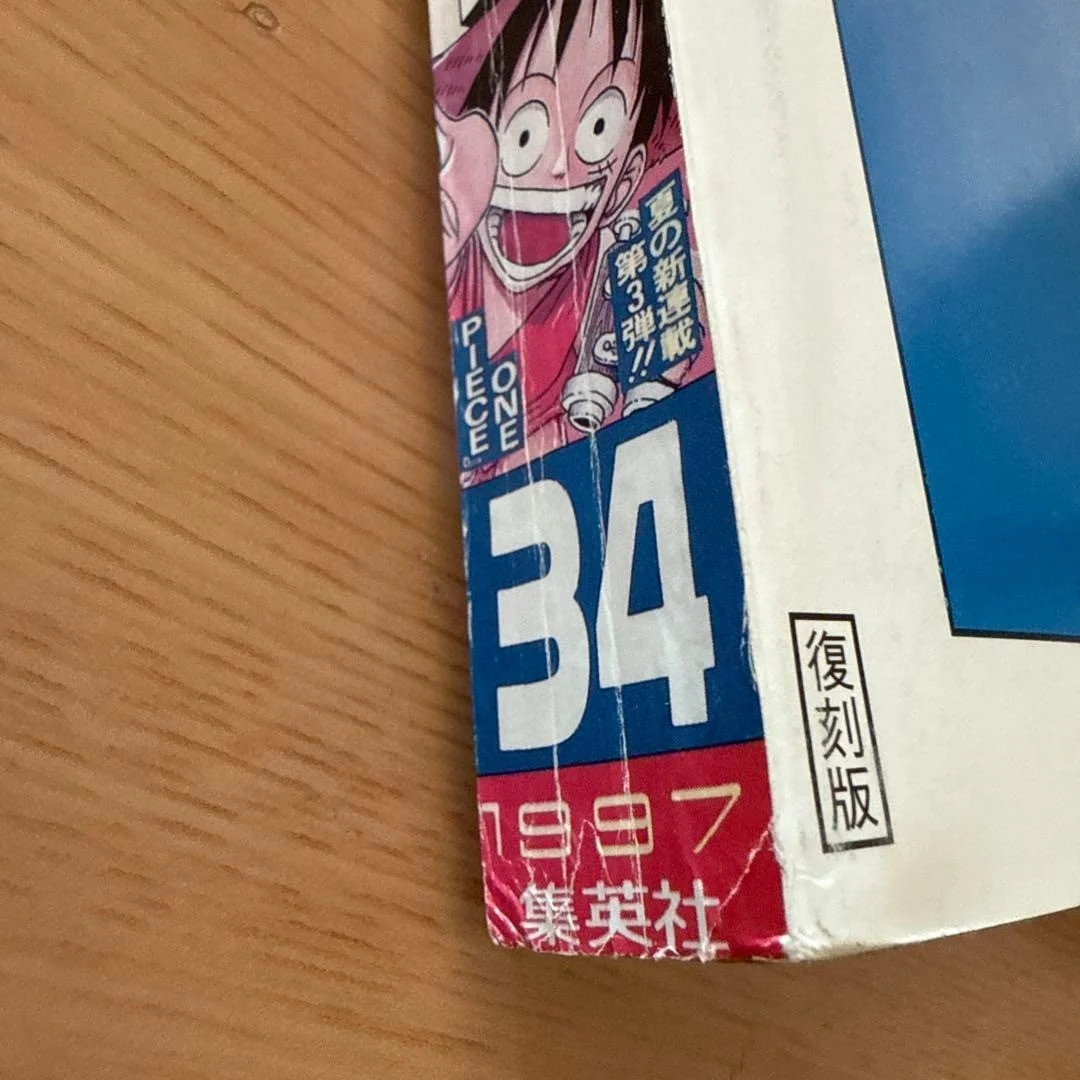
The mark identifies a reprint despite the historical year.
Comparison photographWhy Shueisha released the three packs in 2017
The initiative anticipated Jump’s fiftieth anniversary: the magazine began in 1968 and turned fifty in 2018. Between July and September 2017, three packs were released, each containing two reproduced historical issues. [1] [2]
The selection covered the magazine’s launch, its circulation record, the debuts of JoJo and One Piece, and two story milestones in Hokuto no Ken and Dragon Ball. The facsimiles also reproduced other serials, editorial pages and, where possible, advertising, letting readers experience those chapters in their magazine context. [4] [5]
The six reproduced issues: contents and reasons for their selection
Pack 1 — The first issue and the circulation record
- 1968 issue 1: the inaugural Shōnen Jump.
- 1995 issue 3–4: the issue with the record print run of 6.53 million copies.
The pack documents two periods in the magazine’s history. In 1968 Jump appeared twice a month; it became weekly in 1969. The 6.53 million figure concerns the historical 1995 issue’s print run, not the reprint’s production run. [8]
What the two issues contain
The inaugural 1968 issue contains eight comics, including Gō Nagai’s Harenchi Gakuen, Fujio Akatsuka’s Ōabare Apache-kun and Kazuo Umezz’s Te. Competitions, announcements and editorial pages also reveal a magazine taking shape.
The 1995 issue 3–4 shows Jump at its circulation peak: 22 comics, including Slam Dunk, Dragon Ball, JoJo, Kenshin and Dai, plus a Dragon Ball calendar poster and Masakazu Katsura’s one-shot Shadow Lady. [4]
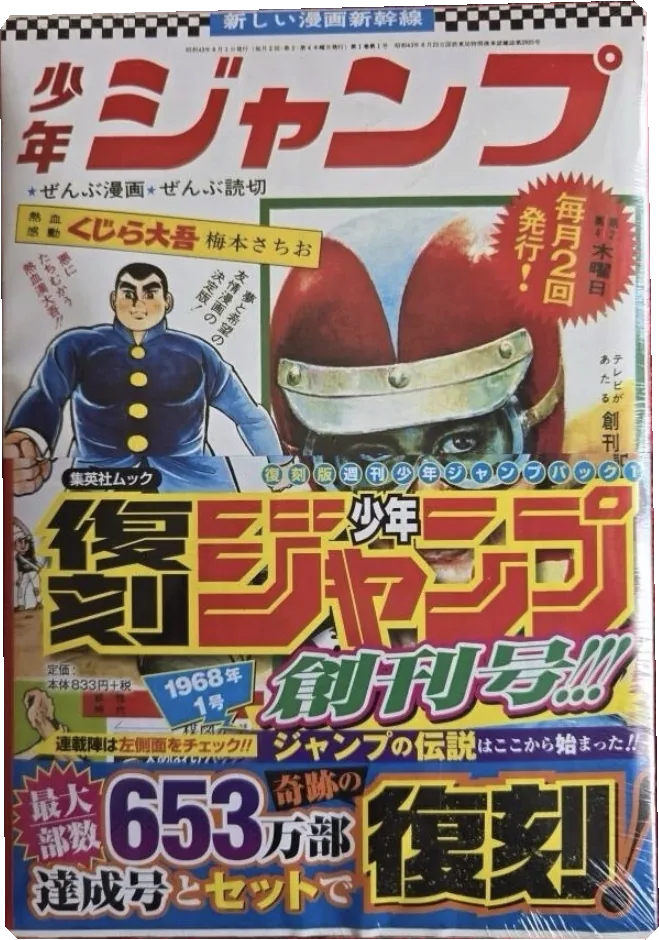
Pack 1: front cover visible on this face of the package, with commemorative band and wrapping.
Community photograph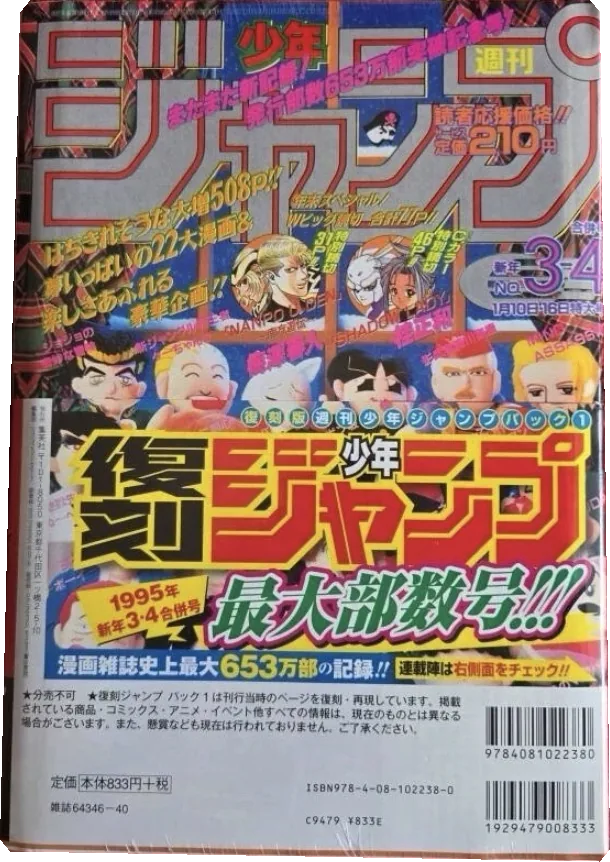
Pack 1: front cover visible on this face of the package, with commemorative band and wrapping.
Community photographPack 2 — The debuts of JoJo and One Piece
- 1987 issue 1–2: JoJo’s Bizarre Adventure begins.
- 1997 issue 34: One Piece begins.
The selection marked JoJo’s thirtieth and One Piece’s twentieth anniversaries, both celebrated in 2017. The two issues contain the start of serialisation, before the collected tankōbon. [2]
What the two issues contain
Issue 1–2 of 1987 is JoJo’s starting point: its first chapter opens Phantom Blood, the story of Jonathan Joestar and Dio.
Issue 34 of 1997 contains One Piece’s first chapter, Romance Dawn: Luffy’s relationship with Shanks, the Devil Fruit and the straw hat establish the promise behind his journey.
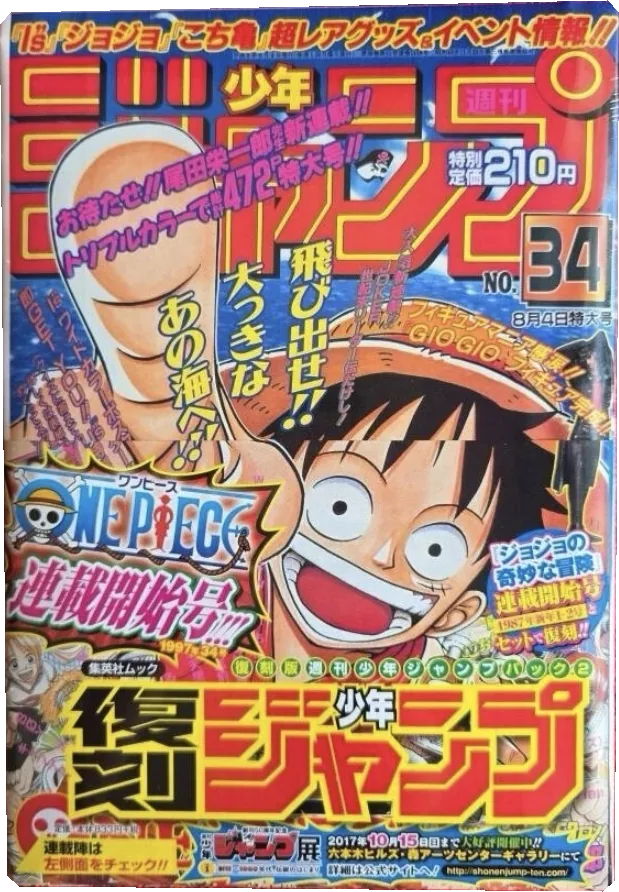
Pack 2: front cover visible on this face of the package, with commemorative band and wrapping.
Community photograph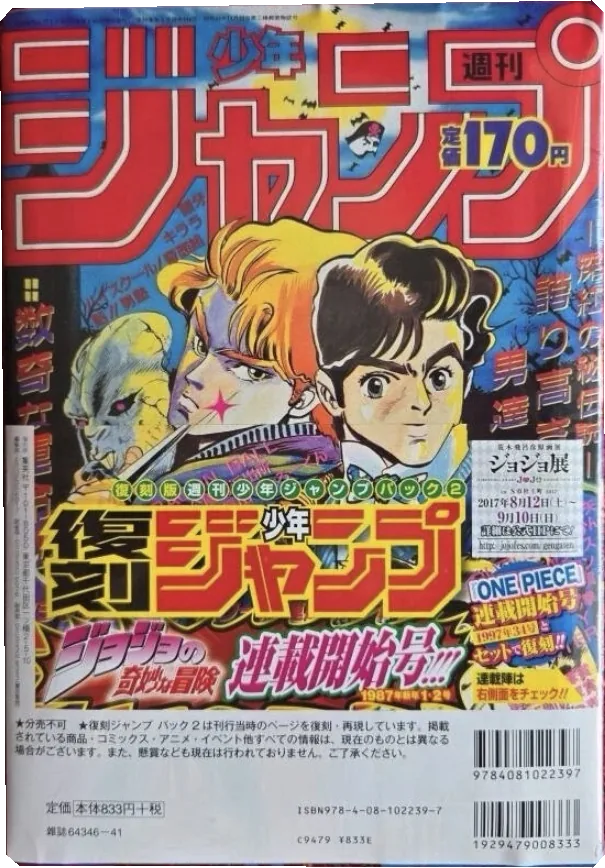
Pack 2: front cover visible on this face of the package, with commemorative band and wrapping.
Community photographPack 3 — Raoh’s farewell and Goku against Freeza
- 1986 issue 26: the conclusion of Hokuto no Ken’s first part, including Raoh’s final scene.
- 1991 issue 21–22: Dragon Ball, Goku’s famous reaction to Freeza mentioning Krillin.
The pack collects two story milestones. The Dragon Ball issue was also chosen for its record reader-poll result. [9]
What the two issues contain
Issue 26 of 1986 contains the conclusion of Hokuto no Ken’s first part: Raoh’s farewell gives the issue its commemorative significance. It also includes Captain Tsubasa, Kinnikuman, Kimagure Orange Road and Saint Seiya.
Issue 21–22 of 1991 features Goku fighting Freeza and reacting to the mention of Krillin; alongside Dragon Ball are Slam Dunk, Video Girl Ai, City Hunter and Yu Yu Hakusho, among others. These issues celebrate story moments, not the series’ first appearances. Dragon Ball’s debut is a different issue: 51 from 1984. [5]
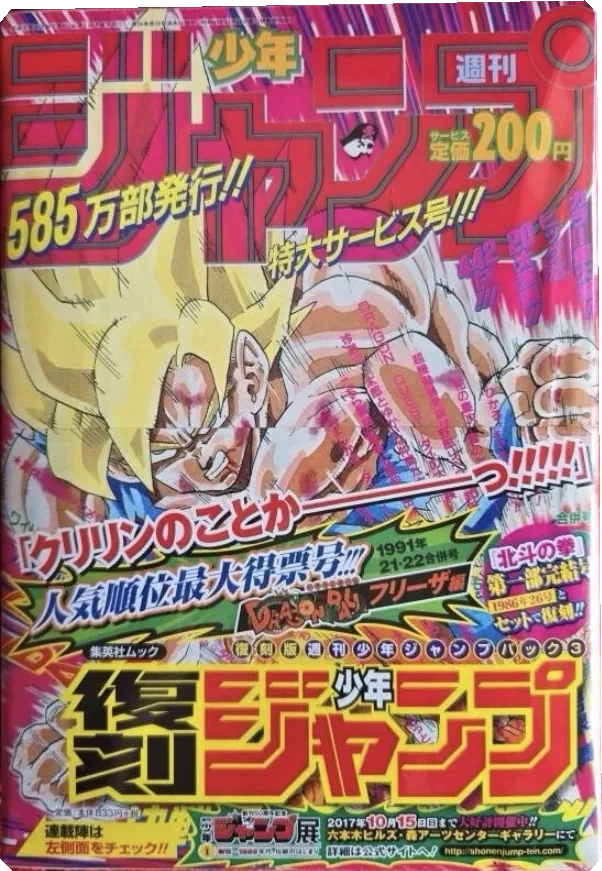
Pack 3: front cover visible on this face of the package, with commemorative band and wrapping.
Community photograph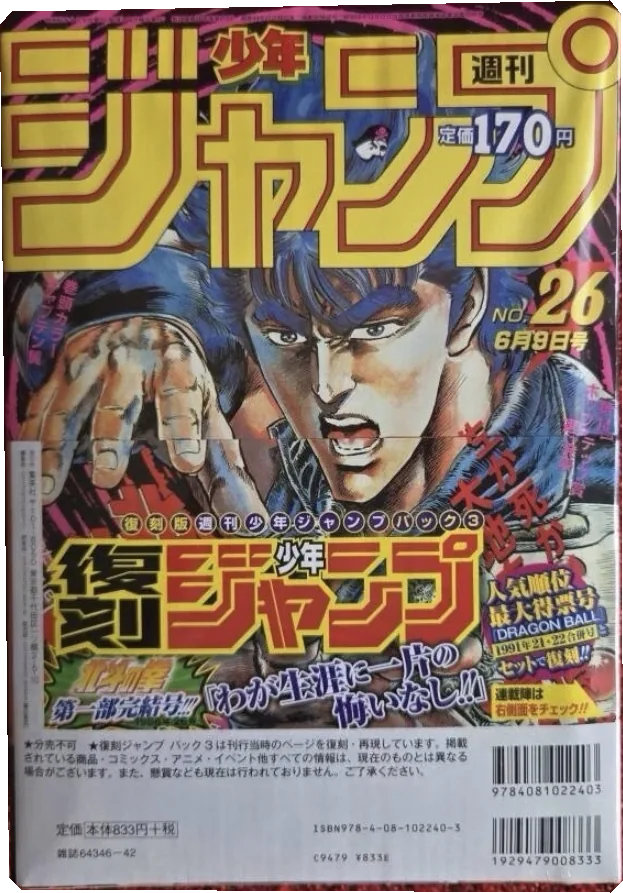
Pack 3: front cover visible on this face of the package, with commemorative band and wrapping.
Community photographSealed packs had a commemorative band and clear wrapping
The three packs were sold sealed in clear plastic, with two issues and a commemorative band. The photographs show both faces and the sides. One face displays the first issue’s front cover and the other displays the second issue’s front cover; neither is an individual magazine’s rear. [4] [5]
The band identifies the pack and carries information for the 2017 product. For example, Pack 2 has ISBN 9784081022397, distinct from the historical details reproduced on the One Piece issue. [3]
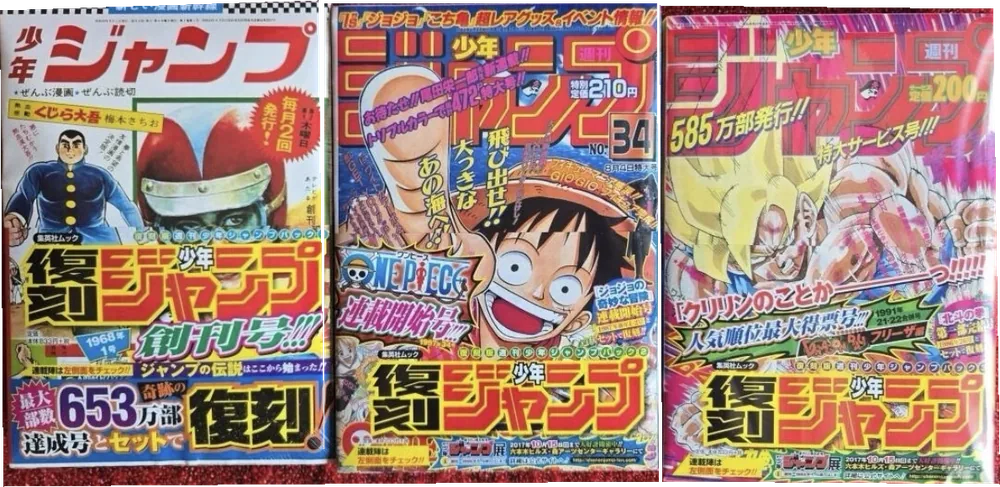
The three packs with publisher bands. Their two main faces show the front covers of the six included issues.
Community photograph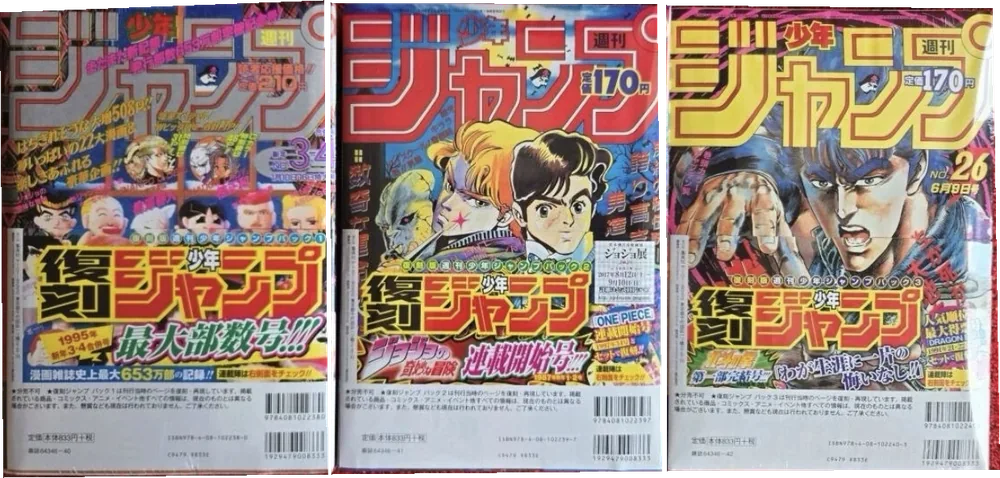
The three packs with publisher bands. Their two main faces show the front covers of the six included issues.
Community photograph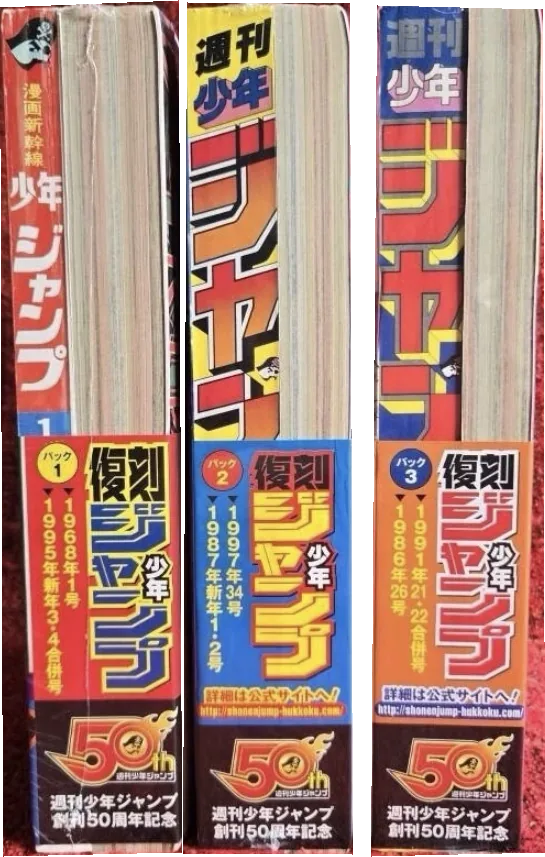
The three packs with publisher bands. Their two main faces show the front covers of the six included issues.
Community photograph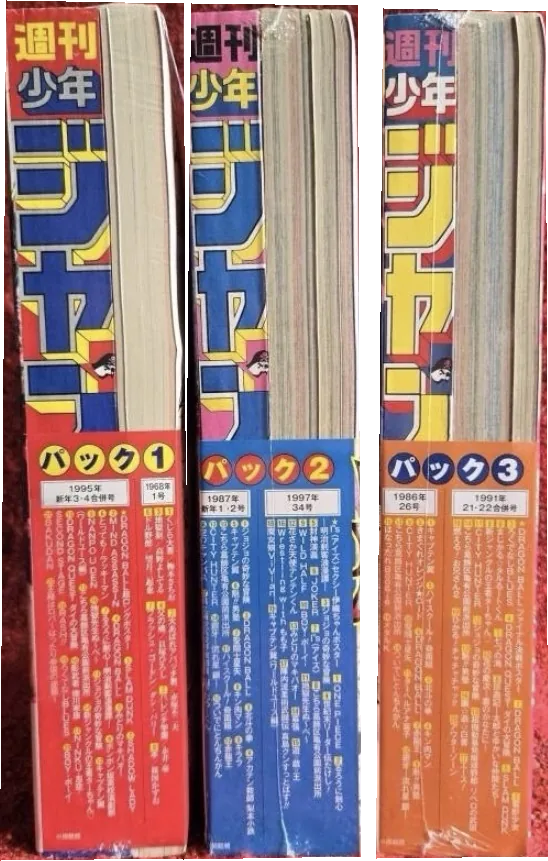
The three packs with publisher bands. Their two main faces show the front covers of the six included issues.
Community photographWhen describing a purchase, distinguish a complete unopened pack, an opened pack retaining its band, and separated issues. A sleeve added by a seller is not the publisher’s packaging: plastic alone does not prove that the pack has never been opened.
Are magazines never reprinted? The Kochikame precedent
New tankōbon print runs can follow demand over time. A weekly magazine moves on to its next issue: reprinting an older issue is a publishing exception, not its normal method of keeping stock available.
But “zasshi are never reprinted” is too absolute. In 2016 Shueisha announced a reprint of Jump issue 42, containing the Kochikame finale, sold from 31 December 2016 with Kochikame Jump. ORICON described it as the weekly magazine’s first reprint. [6]
That case responded to demand for a recently sold-out issue; the 2017 packs recovered magazines from decades earlier. They were different publishing projects.
The photographs to request before buying
- Full front and back photographs of the same copy. The rear photograph should include every edge, especially the bottom-left corner.
- Spine, page edges and binding. These help continue the condition and authenticity check.
- Internal publication information. Request a legible photograph, without mistaking a reproduced historical date for the copy’s printing date.
- Packaging and band, if present. For a closed pack, ask for both sides and the wrapping seams. If the packaging hides an individual issue’s rear, that rear has not yet been checked.
For the One Piece Jump covered here, the blue rear and 復刻版 mark identify the official reprint design. Their absence does not prove authenticity: counterfeits also attempt to imitate the original. Continue with the photographic guide to fake zasshi.
Shueisha has itself issued a warning about pirated copies of Jump 1984 issue 51, Dragon Ball’s debut. This is a separate issue from the authorised 2017 reproductions. [7]
Frequently asked questions about Jump reprints
Does an advertisement on the rear prove it is an original?
No. The JoJo and Dragon Ball reprints photographed in this guide retain advertising. Check for 復刻版 at the bottom left; if that area is not visible, request a complete photograph.
If the spine says 1997, is it original?
No. The reprint reproduces that year and the historical copyright. The photograph of 復刻版 beside 1997 demonstrates this directly.
Is an official reprint a fake?
No: it is an authorised publisher reproduction. It must be identified as a reprint, without assigning it the original’s manufacturing date.
Do all Jump reprints have a blue back?
No. One Piece and Hokuto no Ken have a blue background replacing the advertisement; JoJo and Dragon Ball do not. The shared identifier on all six facsimiles in these packs is the 復刻版 mark at the bottom left of the rear. Always request a complete rear photograph, even when advertising is present.
If it is sealed, is any further check needed?
You still need to identify the product and its packaging. A generic sleeve is not the commemorative pack’s band, and plastic alone authenticates neither the magazine nor the seal.
Can the reprint be collected in its own right?
Yes: it documents a specific publishing initiative and lets you read the issue in context. A period original, a loose reprint and a complete pack are different objects, however; their sales should not be pooled into one price comparison.
Sources for the history and contents of the packs
- [1]National Diet Library · 少年ジャンプ 復刻版 ↗
Bibliographic record of the 2017 collection and the six reproduced issues.
- [2]ORICON · 27.06.2017 ↗
Announcement of the initiative ahead of the 2018 anniversary, release schedule and issue selection.
- [3]Hanmoto · Shueisha, Pack 2 ↗
ISBN 9784081022397 and release on 12 August 2017. The ISBN identifies the pack.
- [4]AkibaBlog · 16.07.2017 ↗
Pack 1 launch report, packaging and reproduction of the historical pages.
- [5]AkibaBlog · 17.09.2017 ↗
Pack 3 launch report, cover with band and commemorative contents.
- [6]ORICON · 07.11.2016 ↗
Announcement of the reprint of Jump 2016 issue 42 with the Kochikame finale, released on 31 December 2016.
- [7]Shueisha · 09.11.2022 ↗
Official warning about pirated copies of Jump 1984 issue 51, distinct from authorised facsimiles.
- [8]Università di Kumamoto · 29.03.2023 ↗
History of the magazine: its initially twice-monthly schedule, circulation record and One Piece’s debut.
- [9]RBB TODAY · 27.06.2017 ↗
The Hokuto and Dragon Ball issues and reasons for their selection. The anniversary falls in 2018, as ORICON clarifies.
The pack photographs and the JoJo and Dragon Ball rear photographs were supplied by the community. The red annotations identify the mark to check. The REPRINT cover is an AI-generated editorial illustration; use the guide’s photographs to identify editions. Research updated on 17 October 2026.