
How to store and care for manga at home
Light, humidity, shelving and protective enclosures: practical care for tankōbon, manga magazines and graded books.
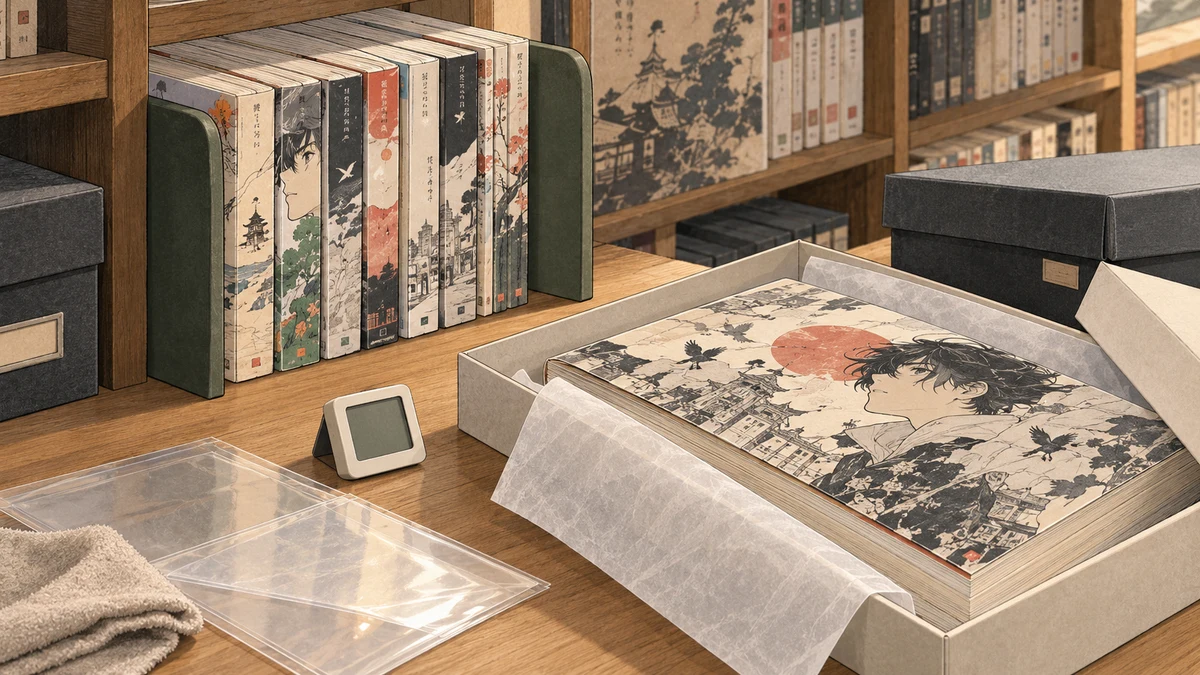
Good manga care starts with where you keep your books and how you handle them. Sleeves, boxes and slabs can help, but they protect against different problems. This guide explains what happens to paper and which precautions make sense for a home collection.
Where to start
Limit light exposure
Avoid direct sunlight. Use a closed cabinet or an opaque box for books you are not consulting.
Monitor the environment
Aim for a cool room and around 40–50% relative humidity. Measure near the books.
Support the book
Keep tankōbon straight and supported. Give large, flexible magazines full support, preferably lying flat.
Handle with care
Use clean, dry hands. Do not force the binding or drag a book out from underneath a stack.
Why manga can turn yellow even in the dark
Paper is not a uniform material. Fibres, lignin, acidity, additives and manufacturing affect how it ages. Inks, adhesives and coatings can also change. Two books stored together may therefore age differently.
Hydrolysis shortens cellulose chains: water takes part in the reaction, while acidity and heat can accelerate it. The paper loses strength. Oxidation can produce compounds that change its colour. Cellulose itself can yellow; lignin is not the only factor.
When light drives these changes, we call it photochemical degradation. This is also a chemical process. Darkness reduces that component without stopping every other reaction. Good care slows change and prevents avoidable damage.
How much light should manga receive?
Avoid direct sunlight: it is intense and can heat the book. Indirect daylight and artificial light can also contribute to damage. What matters is light intensity together with exposure time.
UV-filtering glazing can reduce part of the risk, but visible light still reaches paper and inks. Likewise, an LED should not be treated as harmless simply because it emits little UV.
Turn display lighting off when you are not looking at the collection. For a cover you want to display permanently, consider a reproduction while storing the valuable original safely. Rotating displayed books reduces future exposure; dark storage does not undo earlier damage.
Temperature and humidity: useful targets
There is no need to chase a perfect reading every hour. Choose a suitable environment, measure it and address real problems. These are practical home targets, not boundaries beyond which a book suddenly becomes damaged.
| Factor | Practical target | What it means |
|---|---|---|
| Temperature | A cool room; 15–20 °C where practical | Avoid prolonged heat, radiators and display cases that become hot. 21 °C is not a damage threshold. |
| Relative humidity | Around 40–50% | A practical range consistent with book-care guidance. The Library of Congress also recommends approximately 35–50%. |
| Changes | Avoid large, repeated fluctuations | Paper absorbs and releases moisture, changing dimensions. A consistently hot, damp room is still unsuitable. |
High humidity encourages distortion and, given suitable conditions and enough time, mould. The Canadian Conservation Institute recommends keeping paper collections below 65% RH: this is a preventive limit, not the target to aim for.
Dry and damp conditions are not identical risks. Lower humidity can slow the chemical deterioration of acidic paper, but a manga volume also contains adhesives and covers. Do not try to dry it out as far as possible without control.
Where to keep a collection at home
Choose the location before buying accessories. A regularly used room, away from sunlight and heat sources, is generally easier to manage than a hot attic or a damp basement. A box cannot correct a persistently damp environment.
Keep books off the floor and away from possible water leaks. Do not place the collection against a cold or damp external wall. Use smooth, continuous shelves deep enough to support the whole book.
Measure in the right place
A thermo-hygrometer near the manga, or inside the cabinet, is more useful than a reading across the room. A history or minimum/maximum readings show what happens while you are away.
Address the measured problem
If humidity stays high, consider how to improve the room. If the cabinet gets hot, change its location. More sleeves will not solve either problem.
Clean without wetting the books
Clean shelves and containers periodically. Do not spray cleaning products near books, and let surfaces dry before putting the collection back.
Upright or flat: protecting edges and bindings
Standing a book upright does not automatically damage it. It is suitable for sound, compact tankōbon when they stay straight and have support at both sides. Problems arise when a book leans, bends, is squeezed or rests unevenly.
A large, flexible manga magazine needs more attention: its weight and limited stiffness can encourage distortion. Storing an important copy flat with full support is a cautious application of conservation guidance for large or fragile books, rather than an experimentally proven rule for every magazine.
| Storage method | How to use it |
|---|---|
| Upright tankōbon | Group similar sizes. Use a broad, smooth bookend to support the row without compressing it. |
| Flat magazine | Support the entire volume, preferably in an individual fitted enclosure. Keep every edge within the shelf. |
| Stacked volumes | Keep stacks low and formats compatible. Lift the upper books before taking out the one underneath. |
| Fragile or distorted book | Use an enclosure that supports its existing shape. Do not try to straighten it with weights or pressure. |
Check where the dust jacket and obi rest: an overhanging edge can fold if it bears a load or catches on something. There is no universal safe number of books in a stack; weight, size, stiffness and condition all matter.
Choosing sleeves, boxes and silica gel
A sleeve limits dirt and rubbing; a rigid enclosure adds support; an opaque box also blocks light. These protections are not interchangeable and can be combined.
Look for polyethylene (PE), polypropylene (PP) or polyester PET sleeves without unsuitable additives or coatings. Avoid PVC and unidentified plastics. Boxes and boards touching the book should be acid-free and lignin-free. The word ‘archival’ alone does not adequately specify a product.
Choose a sleeve that lets the volume slide in without forcing corners or the obi. Work on a clean surface and keep closure adhesive away from paper. A buffered board does not automatically deacidify the manga’s pages.
Monitor silica gel
It can help buffer humidity in an enclosure, but results depend on preparation, quantity and how well the container seals. Use a humidity reading: a few forgotten sachets on a shelf do not guarantee a particular RH.
Do not seal in a problem
A damp volume or one with suspected mould does not become safe when bagged. Keep it separate and consider a conservator, especially for an important copy.
Sleeves have no universal expiry date
Check their condition and changes in the material. Replace damaged or unsuitable protection without repeatedly removing the book for unnecessary maintenance.
To choose the right size, see the guide to formats and protective sleeves: measure the copy’s width, height and depth.
How to take out, read and inspect manga
Use clean, dry hands and an uncluttered surface. Cotton gloves can reduce sensitivity and make turning pages harder; they are not automatically the safest choice for books.
Do not pull on the top of the spine. Make room between neighbouring books and grasp the volume gently. Use both hands for a heavy magazine, supporting it underneath. Do not force a binding open to 180 degrees.
Photographs of the covers, page edges and colophon can save repeated inspections of collectible copies. To monitor colour over time, use similar lighting: a phone’s white balance can make paper appear more or less yellow.
If you find damage, avoid improvised repairs. Adhesive tape, sanding and attempted bleaching can alter the book. Protect important copies and seek a conservator’s assessment before intervening.
The guide to alterations explains how to recognise interventions and changes to collectible copies.
What a slab protects against, and when to consider grading
A slab reduces direct contact and many handling risks. Beckett describes a PETG holder and an ultrasonically sealed rigid case for manga. This does not mean the paper stops ageing or that temperature and humidity cease to matter.
The public documentation reviewed did not provide sufficient quantitative specifications to assign a particular UV filtration level, watertightness or humidity control to BGS manga slabs. Keep graded books away from sunlight and in a suitable environment.
Bagging a comic does not stop every chemical process either. A University of Pisa study detected volatile compounds inside archival bags containing comics. It did not establish that those bags were worse than open storage, and it did not test BGS slabs.
If you plan to certify an exceptional copy, protect it immediately and consider grading before further handling or poor storage introduces defects. There is no reliable ‘one year equals a fixed grade loss’ formula: materials, environment and damage can produce very different outcomes.
Market value is a separate consideration. Grading can help where buyers pay a premium for certification, but demand, completeness, fees and shipping risks still matter. A raw copy can also be stored well; the decision to grade depends on your plans for the book.
For grades, labels and separate book and dust-jacket assessments, continue with the BGS grading guide.
A simple routine for your collection
You do not need to remove and inspect every volume constantly. Start with environmental readings and the outside of enclosures, then investigate when something changes.
When a new manga arrives
Check for unusual odours, moisture, distortion and possible pests before placing it with the collection. Record its condition without forcing the book.
When the season changes
Review temperature and humidity history: central heating and summer heat can change conditions inside the cabinet.
When you rearrange the collection
Check supports, stacks, overhanging edges and sleeves. Correct the support if a volume starts leaning or bending.
When a problem appears
New spots, a mouldy smell or dampness need attention. Separate the suspect copy and investigate the cause before returning it to the collection.
Frequently asked questions about manga care
The question about darkness came from the community. It is a useful starting point for separating effective protection from false reassurance.
Should manga be kept in the dark to prevent yellowing?
Darkness reduces light-induced damage but does not stop every reaction in paper. Avoid direct sunlight and limit exposure when books are not in use. A cool environment and controlled humidity also matter.
Does storing manga upright damage the edges?
Not necessarily. A sound tankōbon can stand upright if it is straight, fully supported and held at both sides. Leaning, compression and overhanging edges increase risk. Flat storage with full support is often a cautious choice for large, flexible magazines.
Does a clear sleeve also protect against light?
Do not assume this without material specifications. Even a UV filter transmits visible light, which can damage paper and colours. Use an opaque box or a closed cabinet to reduce exposure during storage.
Is adding silica gel to a box enough?
No: its effect depends on the gel, the amount and the enclosure. Measure humidity and check the result over time. Silica gel does not replace correcting a persistently damp room.
Does a BGS slab stop manga from ageing?
No. It protects against many handling risks but does not stop paper chemistry or replace a suitable environment. Graded manga should also be kept away from sunlight and prolonged heat.
Will waiting to grade a manga definitely lower its score?
There is no fixed loss linked to time. New defects and deterioration can affect condition, but there is no reliable conversion from years to BGS grade points. If you plan to grade, protect the copy now and weigh timing, costs and risks.
Sources and further reading
This guide draws on paper and book conservation guidance, scientific studies and grading-service documentation. Advice for tankōbon and manga magazines applies those principles to these formats; fragile or damaged copies may require an individual assessment.
- Library of Congress · The Deterioration and Preservation of Paper
- Mosca Conte et al. · Physical Review Letters, 2012 · Role of Cellulose Oxidation in the Yellowing of Ancient Paper
- Shūeisha · intervista a Taishi Tsutsui / interview · 少年ジャンプ漫画賞ポータル
- Library of Congress · Limiting Light Damage
- NEDCC · Protection from Light Damage
- Library of Congress · How do I preserve my books?
- Canadian Conservation Institute · Caring for paper objects
- Canadian Conservation Institute · Incorrect temperature
- Library of Congress · Storing Your Books
- Library of Congress · General Preservation FAQ
- NEDCC · Monitoring Temperature and Relative Humidity
- Canadian Conservation Institute · Basic Care of Books · Notes 11/7
- Canadian Conservation Institute · Making Enclosures for Books and Paper Objects
- NEDCC · Storage and Handling for Books and Artifacts on Paper
- Canadian Conservation Institute · Silica Gel: Passive Control of Relative Humidity
- Canadian Conservation Institute · Mould Prevention and Collection Recovery
- Library of Congress · Books: Preservation FAQ
- Canadian Conservation Institute · Basic care – Paper documents and newspaper clippings
- Beckett · Manga Grading, Authentication, Encapsulation
- Beckett · Manga Grading Scale
- La Nasa et al. · Università di Pisa, 2019 · Comics’ VOC-abulary: Study of the ageing of comic books in archival bags through VOCs profiling
- Canadian Conservation Institute · Storing Works on Paper · Notes 11/2
Sources consulted on 17 October 2026. Environmental recommendations are practical targets, not a preservation guarantee or universal damage thresholds.